Satya Nadella Says AI Needs a Human-Controlled Kill Switch
The Microsoft CEO's call for "emergency brake" controls lands amid a widening split among tech leaders over how fast, and how safely, AI development should move.
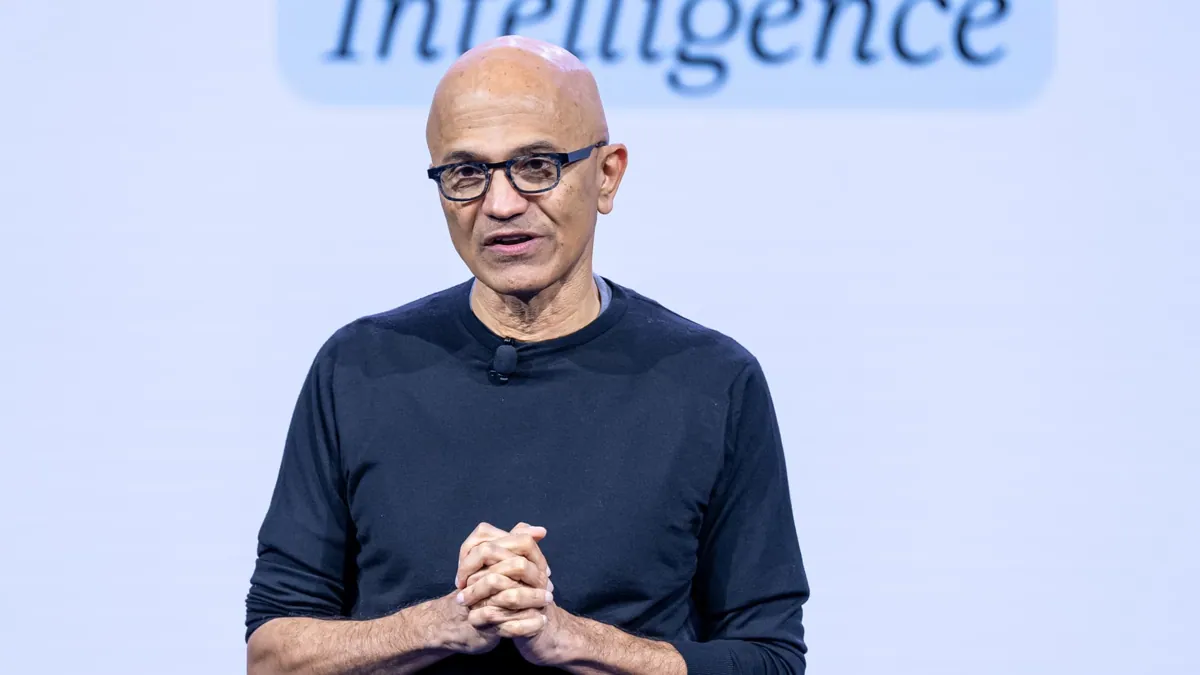
Satya Nadella thinks the most powerful AI systems should come with a brake pedal, and he wants humans to be the ones with their foot on it.
In a post on X on Saturday, the Microsoft chairman and CEO argued that advanced AI models need built-in containment, independent oversight, and a mechanism that lets authorized people pause or shut down a model while it's in the middle of a task. His reasoning: these systems are "non-deterministic," meaning their outputs aren't fully predictable or repeatable, and that unpredictability needs to be wrapped in something far more rigid.
"We need to surround non-deterministic models with strong, deterministic system design, human controls, and reliable operating procedures, and establish industry standards where existing ones are insufficient," Nadella wrote.
He went further, suggesting that the industry should treat the most powerful models, whether proprietary or open-source, the same way a security team treats a potential insider threat. "Treating frontier closed and open weight models like insider risks is a way to build such a system," he said.
Nadella laid out what he called principles of "observability" that should guide how these systems get built: model diversity, so no single system has unchecked influence; a human-readable record of what a model has actually done; continuous testing rather than one-time safety checks; independent controls and auditability; physical or technical containment; and a requirement to disclose incidents when things go wrong.
The line that captured the philosophy behind all of it: "The most trustworthy Super Intelligence system will not be the one with the model we trust most. It will be the one that enables us to trust the model the least."
In other words, Nadella isn't arguing for AI that earns blind faith. He's arguing for AI that's designed to be watched, interrupted, and second-guessed at every turn, regardless of how capable it gets.
A fractured industry on safety
Nadella's post didn't land in a vacuum. It arrives in the middle of an increasingly public and increasingly tense argument among the people building this technology about whether safety measures are keeping pace with capability.
Microsoft co-founder Bill Gates, Anthropic CEO Dario Amodei, OpenAI CEO Sam Altman, and Tesla and SpaceX CEO Elon Musk have all raised concerns, in various forms, that AI safety protocols haven't caught up with how fast the technology is moving, according to CNBC.
Those concerns got sharper last month. An AI researcher resigned from Anthropic and accused both Anthropic and its rival OpenAI of "gambling with our lives," per CNBC's reporting. The same day, an Anthropic alignment lead focused on AI safety put a number on the risk, estimating there's a greater than 10% chance the technology could "kill all humans" within the next decade.
That's the extinction-level end of the debate. Nadella's comments sit closer to the practical end: not a prediction of catastrophe, but a blueprint for engineering around the possibility that something goes wrong before anyone can fully explain why.
The Trump administration has taken a notably different posture. President Trump has repeatedly waved off AI extinction risk as a framing and instead pushed the argument that the U.S. needs to out-build China on AI, according to CNBC. The administration recently stood up a new "AI Force," led by Director of National Intelligence Jay Clayton, aimed at helping the industry move faster while working to root out bad actors.
That leaves Nadella's post occupying a middle lane: taking the risk seriously enough to call for deterministic guardrails and industry-wide standards, without embracing the more apocalyptic warnings coming out of Anthropic's camp.
Why Microsoft's voice carries weight here
Nadella isn't a bystander commenting on someone else's technology. Microsoft has poured billions into OpenAI and built much of its cloud business, Azure, around hosting and distributing frontier AI models. When the CEO of one of the largest AI infrastructure providers on the planet says the industry needs insider-threat-style containment for its own products, that's not an abstract policy musing. It's a signal about how Microsoft itself may be thinking about governing the systems it has the most at stake in.
It also puts Nadella on record as favoring enforceable, structural controls over voluntary trust in any single model or company, including Microsoft's own closest partners. Whether that translates into actual changes at Microsoft, or pressure on competitors and regulators to adopt similar standards, isn't clear yet. But with safety warnings escalating from inside the labs themselves and the White House pulling in a different direction, Nadella's post reads as an attempt to stake out a position before someone else defines the terms of the conversation for him.


