Nadella Publicly Slams Anthropic's AI Guardrails, Even as Microsoft Bankrolls the Company
The Microsoft CEO told staff that Fable's content restrictions "doesn't make sense," a rare public jab at a partner that just took $5 billion from Microsoft and committed $30 billion to its cloud.
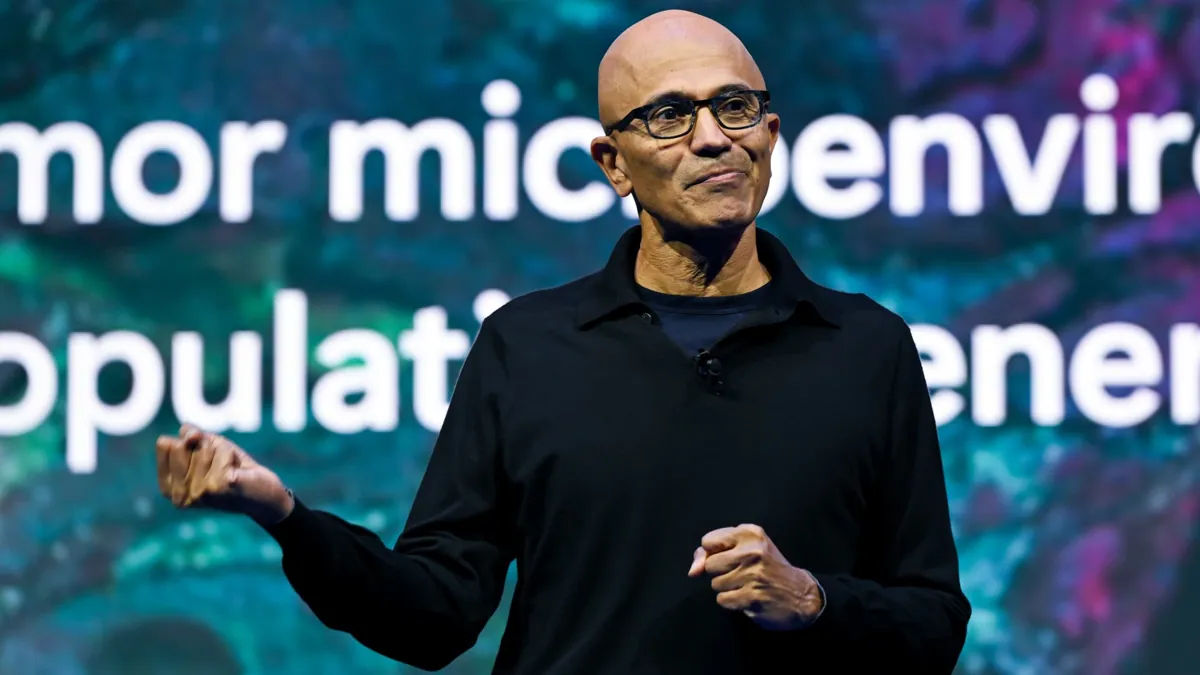
Satya Nadella spent part of a Wednesday meeting with his own engineers criticizing one of Microsoft's most important AI partners. The target was Anthropic's Fable model, and the complaint was blunt: its restrictions on user requests, Nadella said, don't make sense.
"If you use Fable, when it refuses for any random thing, it just is like, when was the last time you had a creation tool that was so editorially controlled?" Nadella told engineers working on Copilot, according to a copy of his remarks obtained by CNBC. "It doesn't make sense."
That's a pointed thing for Nadella to say about Anthropic, given how tightly the two companies are now linked. Microsoft announced a $5 billion investment in Anthropic in November, and Anthropic agreed in turn to spend $30 billion on Microsoft's Azure cloud. Anthropic's Claude Code has also become a go-to tool for developers, including plenty of people without deep coding backgrounds. Earlier this year Microsoft launched Copilot Cowork, a business assistant that runs partly on Anthropic's models. In short, Anthropic is both a client and a supplier, and Nadella just publicly needled its flagship product.
What's actually going on with Fable
The specific gripe is about how Fable handles certain requests, including questions related to building large-scale AI models. According to an Anthropic support page, in some cases the system will quietly serve up answers from an older, less capable version of the model rather than fulfilling the request outright. Users have complained about this behavior on social media.
Anthropic has acknowledged the tension. When it rolled out Fable 5 in early June, the company said it was working to cut down on false positives, meaning legitimate requests that get wrongly blocked. But the rollout got complicated fast. Three days after launch, Anthropic pulled Fable access entirely to comply with a U.S. government export control directive. It restored access on July 1, but with a caveat: the company said the new safeguards would flag "a slightly higher fraction of harmless requests" than the previous version did. So the restrictions Nadella is complaining about aren't a bug so much as a deliberate, if imperfect, tradeoff Anthropic made under regulatory pressure.
Neither company would elaborate. Microsoft declined to comment, and Anthropic did not immediately respond to a request for comment.
The bigger argument Nadella is making
The Fable comments didn't happen in isolation. They're part of a broader case Nadella has been building about who should control AI infrastructure, and at what cost. His view: companies ought to be able to build custom models cheaply using their own internal data, rather than depending entirely on frontier labs and letting sensitive data flow out to third parties.
In a blog post over the weekend, Nadella cited Palantir CEO Alex Karp, who has argued that technical organizations "want to know they own the means of production." Nadella took that further with the engineers, framing the current AI market as dangerously concentrated.
"It can't be that there are only two companies in the world with token capital, and everybody else is renting it," he said. "It makes no economic sense." Tokens are the unit that measures how much computing an AI model is actually using, and Nadella's point is that if only a couple of labs effectively control the supply, everyone else is stuck paying rent indefinitely.
That framing lines up with a shift already underway in the industry. Executives across tech are increasingly interested in cheaper models, not necessarily from the biggest, best-funded labs, that can still handle everyday work like software development. The timing reinforced Nadella's point: a day after his remarks, Chinese startup Moonshot AI announced an open-source model it claims outperforms recent releases from both Anthropic and OpenAI.
Microsoft's own moves reflect this thinking. The company runs Foundry, a service offering developers access to more than 11,000 models, including ones from Anthropic and OpenAI alongside plenty of alternatives. In June, Microsoft rolled out its own in-house models, including one built specifically for coding.
The OpenAI shadow
It's hard to read Nadella's comments without thinking about Microsoft's other, messier AI relationship. Microsoft tied itself closely to OpenAI through a series of investments, a stake now worth $135 billion as of October. But the partnership frayed after OpenAI's board abruptly ousted, then reinstated, CEO Sam Altman in 2023, catching Nadella off guard. Since then, the two companies have increasingly become competitors as much as partners. In April, OpenAI said it would expand its models onto Amazon Web Services, moving beyond its Azure exclusivity.
Against that backdrop, Nadella's willingness to criticize Anthropic reads less like a one-off shot and more like a consistent posture: Microsoft doesn't want to be permanently dependent on any single AI lab, no matter how close the financial ties.
That posture matters to investors, too. Microsoft is pouring tens of billions of dollars per quarter into data center buildouts, and there's real concern about whether fast-improving AI coding tools could eventually undercut the value of that spending. Microsoft's stock is down 17% this year while the Nasdaq Composite has gained 11%, a gap that underscores the market's unease.
Nadella also touched on more internal matters in the meeting, saying Microsoft's push to unify its consumer and business Copilot products under one roof is overdue. "We should have done maybe day one," he said. Former Snap executive Jacob Andreou took over leadership of Copilot across both segments in March. As of April, Microsoft had more than 20 million paid seats for the work-focused version of Copilot, roughly 4% of its cloud-based Office customer base.
Taken together, the remarks paint a picture of a CEO trying to pull off a delicate balancing act: staying close enough to Anthropic and OpenAI to benefit from their models, while publicly signaling that Microsoft doesn't intend to be at the mercy of either one.


