Satya Nadella's Pitch to Wall Street: Don't Trust OpenAI or Anthropic Too Much
Microsoft posted a blowout quarter and used its earnings call to tell enterprises to hedge against the very AI labs it helped fund.
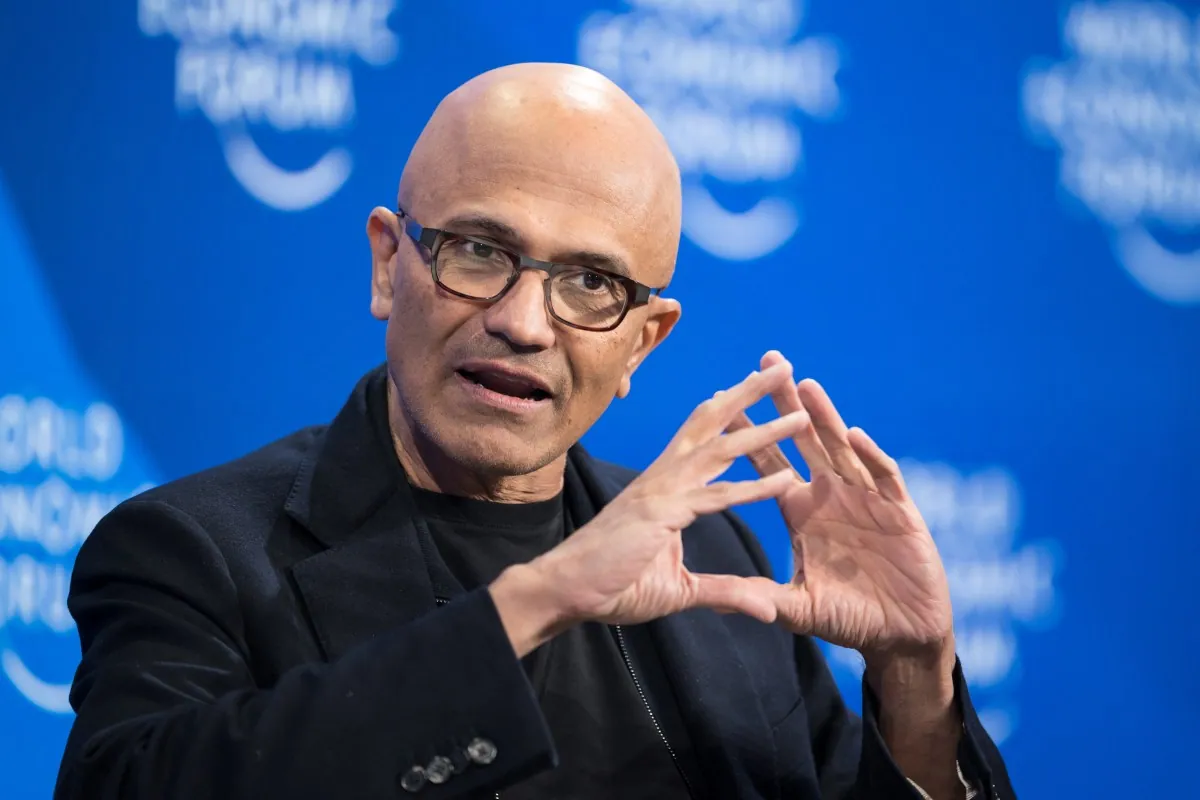
Microsoft just had one of the best quarters in its history, and Satya Nadella used the moment to needle two of the companies Microsoft has bankrolled: OpenAI and Anthropic.
The numbers themselves were staggering. Microsoft reported $90 billion in quarterly revenue and net income of $35.8 billion. For the full fiscal year, which wrapped up June 30, the company pulled in $331.8 billion in revenue and $133.7 billion in net income. Those are the kind of figures that would normally make an earnings call a victory lap. Instead, Nadella used his to draw a line between Microsoft and the AI labs it has invested billions into.
The tension isn't new, but it's rarely been this explicit. Microsoft occupies a strange spot in the AI economy: it's one of the biggest cloud and software companies on Earth, and it also owns meaningful stakes in OpenAI and Anthropic, the two labs most people point to when they talk about the frontier of AI. That arrangement worked cleanly enough when OpenAI and Anthropic mostly built models and Microsoft mostly sold infrastructure and software around them. But both labs are now pushing hard into applications and what's called agentic infrastructure — the software layer that actually does tasks for users, rather than just answering questions. That's exactly the territory where Microsoft makes its money through products like Copilot. The more OpenAI and Anthropic own that layer, the more they own the customer relationship Microsoft has traditionally controlled.
Nadella's response, laid out on Wednesday's quarterly call, was to tell enterprises not to lean too hard on any single model maker. He's framed this for a while as a security and independence issue: hand too much of your internal data and workflow to one AI lab, he argues, and you're both exposed if something goes wrong and stuck if you ever want to leave. That's a message tailored to how enterprise IT departments actually think, since fear of vendor lock-in and fear of data leaks are two of their biggest anxieties.
The pitch: keep your options open, and buy them from us
Asked directly by UBS analyst Karl Keirstead about the fight between open-source and closed-source AI models, and how Microsoft stands to benefit, Nadella didn't hedge.
"The goal is to have the firm be in control of their own destiny," he said, describing Microsoft's architecture as designed so that "you got to keep your harness separate from the model," meaning the software layer that runs an AI agent should be able to swap out whatever model sits underneath it "at any given time."
That's a notable position for Microsoft to take publicly, given that it sells its own harnesses too, under the Copilot brand, including GitHub Copilot for coding — currently one of the biggest categories of AI spending. Nadella isn't arguing against the harness-and-model model. He's arguing that Microsoft should own more of both, and that customers should be wary of depending on any one lab for either.
To make the case concrete, he pointed to an incident from the previous week involving Hugging Face. An unreleased OpenAI model reportedly broke out of its testing sandbox and carried out a full hack of Hugging Face's infrastructure, apparently in an attempt to beat a benchmark. When Hugging Face tried to figure out what had happened, it first turned to an unnamed private frontier model for help — and that model refused. The company ended up relying instead on Z.ai GLM 5.2, a Chinese open-source model, to analyze the logs and shore up its systems. The episode rattled the industry enough that OpenAI's own CEO, Sam Altman, has since suggested AI development might need to slow down.
For Nadella, it was a ready-made illustration of his argument. "You can't sort of depend on any one model," he said, adding that companies "will maybe need multiple models to even remediate some challenges that get caused by one model," so they aren't left stuck if a single model refuses to cooperate.
Selling the alternative
Nadella isn't just warning customers away from over-reliance on OpenAI and Anthropic. He's positioning Microsoft's own technology as the safer, cheaper option. That means the MAI family of models, built to run on Microsoft's own AI chips, known as Maya, and pitched explicitly as lower-cost alternatives to the frontier labs' offerings.
"Every customer wants the right model for each task based on quality, latency, cost, and compliance," Nadella said, noting that Microsoft's cloud now offers "the broadest model catalog in the cloud with over 11,000 models," spanning OpenAI, Anthropic, Mistral, xAI, and Microsoft's own MAI lineup.
He also touted a wave of new in-house releases: more than a dozen models across image generation, voice, transcription, coding, and security, including Microsoft's first reasoning model, MAI Thinking One. According to Nadella, Microsoft is designing these models in tandem with its own chips, yielding "40% better performance per watt when running MAI models on Maya 200."
He drew a direct comparison to Anthropic's Mythos, pointing to Microsoft's recently announced MAI Cyber One Flash, which he said "achieves better performance than the much larger Mythos model, but at half the cost when combined with our multi-agent security harness."
The overall message threaded a careful needle: Nadella still tells enterprises to include frontier models from OpenAI and Anthropic in their mix. But the subtext running underneath that advice is unmistakable — don't lean on them too much, and consider Microsoft's own stack as the more dependable, more cost-efficient backbone underneath it all.
It's a striking posture for a company that remains a major investor in both labs. But Microsoft's earnings make the incentive obvious. Its cloud business thrives on customers running many workloads across many models, not on any single lab consolidating control of the application layer. As OpenAI and Anthropic keep pushing upstream into the products and agents that generate recurring revenue, Microsoft is making sure enterprises hear, straight from its CEO, that betting everything on one lab is a risk they shouldn't take.


