SK Hynix Is Coming to the Nasdaq, and It Wants $29 Billion to Feed the AI Memory Boom
The South Korean chipmaker behind Nvidia's AI hardware is going public in the U.S. after a stock rally that turned it into a trillion-dollar company.
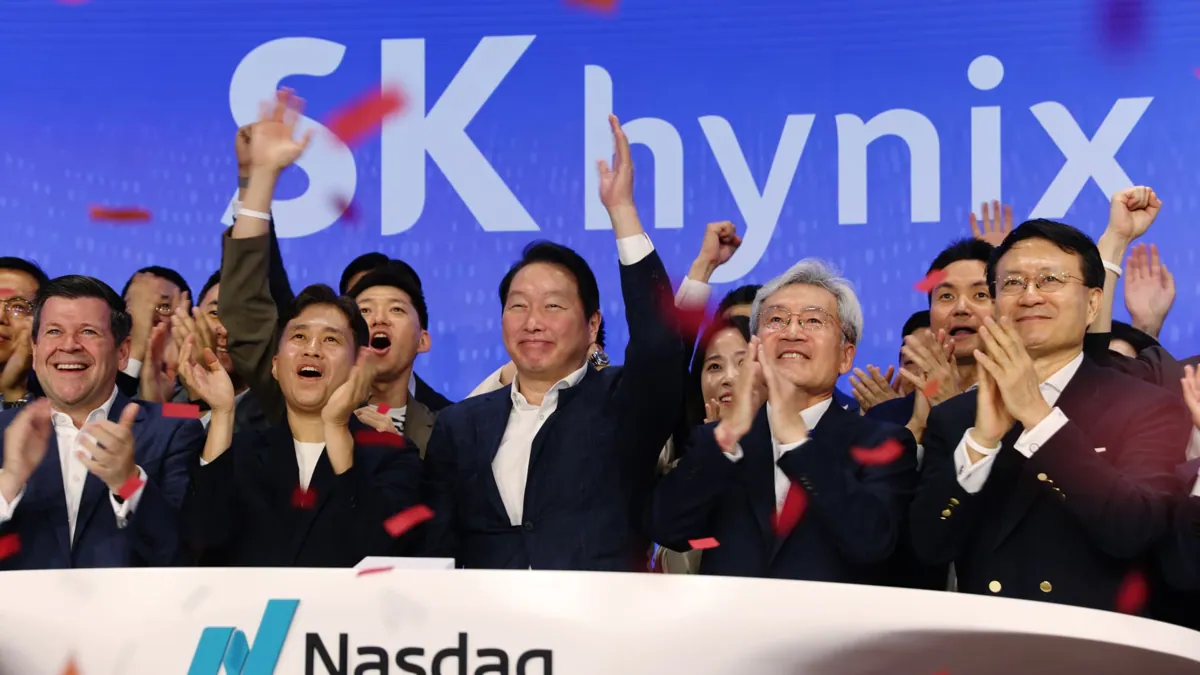
SK Hynix is about to become a lot more familiar to American investors. The South Korean memory chipmaker is set to start trading on the Nasdaq on Friday under the ticker SKHY (SKHYV to start), a debut that arrives on the back of a stock that's climbed more than sevenfold in the past year and pushed the company's market cap to roughly $1 trillion.
Most people outside the chip industry have never heard of SK Hynix. But odds are good they've owned something with its chips inside. Along with Samsung and Micron, SK Hynix is one of just three major producers of the memory chips that sit inside laptops and phones from the likes of Apple and Dell. For years, that business was considered one of the more unglamorous corners of semiconductors. Then artificial intelligence happened.
Why memory suddenly matters
The AI boom has created severe shortages of memory chips and pushed prices to record highs, upending a market that used to run on predictable, boring cycles. SK Hynix sits at the center of the shift because it's the leader in high-bandwidth memory, or HBM, the specialized chip that powers Nvidia's AI processors. Ordinary memory chips, often called RAM, are relatively simple components that every computer needs to store data. HBM is a different animal: it stacks multiple layers of memory together to move data faster, which is exactly what AI workloads demand. SK Hynix was first to pull this off at scale, and analysts expect the company to control more than half the HBM market this year.
That position has made SK Hynix one of Nvidia's most important partners. In June, Nvidia CEO Jensen Huang visited the company during a trip to Seoul, where the two announced a multiyear supply partnership. Nvidia is the single largest buyer of HBM in the world.
"That advantage has positioned SK Hynix as one of the biggest beneficiaries of the rapid growth in AI infra," said TrendForce analyst Ellie Wang.
The Nasdaq listing and the U.S. build-out
SK Hynix plans to raise about $29 billion through the Nasdaq listing by issuing American depositary receipts, according to a regulatory filing, with the money earmarked for new factories and equipment. Some of that expansion is already underway on American soil. The company is building its first U.S. production facility, a $4 billion plant in West Lafayette, Indiana, expected to open in 2028. That plant will handle advanced packaging, the process of connecting and stacking individual chips into the larger systems needed to make HBM.
The Indiana project comes with government backing. SK Hynix expects to receive up to $458 million through the CHIPS and Science Act, the 2022 law aimed at reviving domestic chip manufacturing, plus up to $570 million in loans from the U.S. Commerce Department.
HBM isn't the whole story, either. The broader memory shortage triggered by AI demand has also driven up prices for conventional RAM used in phones, tablets, PCs, cars, and medical devices, lifting profit margins across the board. More than three-quarters of SK Hynix's revenue comes from RAM, HBM included. The company is also the market leader in NAND flash storage, holding 19% share in the first quarter, according to IDC.
The growth numbers are striking. Annual revenue nearly tripled between 2023 and 2025, landing around $65 billion. Analysts polled by LSEG expect it to more than triple again in 2026, to roughly $235 billion.
A history of feast and famine
SK Hynix's rise hasn't been a straight line. The company started in 1983 as Hyundai Electronics, part of the Hyundai conglomerate. It merged with LG Semicon in 1997 during a financial crisis, at a time when memory prices were collapsing under a supply glut. It rebranded as Hynix Semiconductor in 2001, then became SK Hynix in 2012 after SK Telecom bought a controlling stake. According to an SEC filing, SK Square, which split off from SK Telecom in 2021, currently holds a 20.5% stake.
That boom-and-bust pattern is the backdrop for the current AI-driven rally. Big technology shifts, the dot-com era, the smartphone explosion, the move to cloud computing, have repeatedly triggered memory shortages followed by oversupply and price crashes. Given how fast AI demand has grown, that concern hasn't gone away. This time, though, SK Hynix and its rivals are trying to get ahead of the volatility. The company, along with Micron and Samsung, is increasingly locking in long-term supply contracts that guarantee prices and orders years in advance, a departure from the quarterly or annual deals that used to be standard. Companies including Apple are scrambling to lock in supply under these arrangements.
"These agreements typically require customers to provide longer-term demand visibility," Wang said, giving SK Hynix more confidence in planning its own spending.
Not everyone is convinced the cycle has actually changed. Daniel Newman, an analyst and CEO of Futurum Group, said investors need to weigh today's stock price against memory's track record. "This is how memory always acts in any megacycle or supercycle," Newman said. "The problem is, it always crashes hard." He added that if AI demand holds up over the coming years, companies like SK Hynix could still turn out to be a bargain at current prices. Industry watchers point to what they call the "memory wall," the idea that AI systems need ever-increasing amounts of memory to keep functioning, and memory makers themselves don't expect the current shortage to ease before 2027 at the earliest.
Betting big at home and abroad
SK Hynix is spending accordingly. In South Korea, the company plans to invest up to $720 billion expanding its manufacturing footprint to keep pace with AI-driven demand. The centerpiece is a $390 billion cluster of fabrication plants in Yongin, just south of Seoul, where SK Hynix has accelerated its timeline by more than a decade, now targeting completion of four fabs by 2033. The company is also expanding facilities in Cheongju and building a new manufacturing cluster in southwestern South Korea.
All of that requires enormous amounts of specialized equipment, particularly extreme ultraviolet lithography machines, or EUV tools, which etch the intricate circuitry needed for advanced chips like HBM. These machines are made exclusively by ASML in the Netherlands, cost up to $400 million apiece, and are notoriously hard to get. SK Hynix's SEC filing shows plans to spend around $7.8 billion on new EUV machines by the end of 2027.
"If you go to Korea they are building lots of fabs," said MS Hwang, research director at Counterpoint. "But it takes time. The earliest time frame that they can bring out manufactured wafers is end of 2027."
Beyond Indiana, SK Hynix has other U.S. ambitions. In January, the company said it had set aside $10 billion for an initiative called AI Company, aimed at developing new product lines and backing American businesses. Its biggest piece is Solidigm, the NAND flash maker SK Hynix bought from Intel in 2021 for $9 billion. Solidigm is now headquartered in Rancho Cordova, California, where it's developing new solid-state drives capable of storing more data.
Still, the center of gravity remains South Korea, where demand for supply deals has turned into a genuine crush. "Everybody is coming," Hwang said, describing the rush of companies signing long-term contracts. He added that nearby hotels are "fully booked" as cloud providers and chipmakers line up to secure their piece of SK Hynix's output.
The Nasdaq debut gives American investors direct access to that story for the first time, betting alongside SK Hynix that the AI memory crunch has years left to run, even if history suggests the reckoning eventually comes.


