Nvidia's Pitch to Europe: Skip the Years-Long Data Center Build, Plug In Instead
At Nvidia's Berlin conference, Jensen Huang unveiled a shipping-container AI factory and a robotics push aimed at turning Europe into an AI producer, not just a buyer.
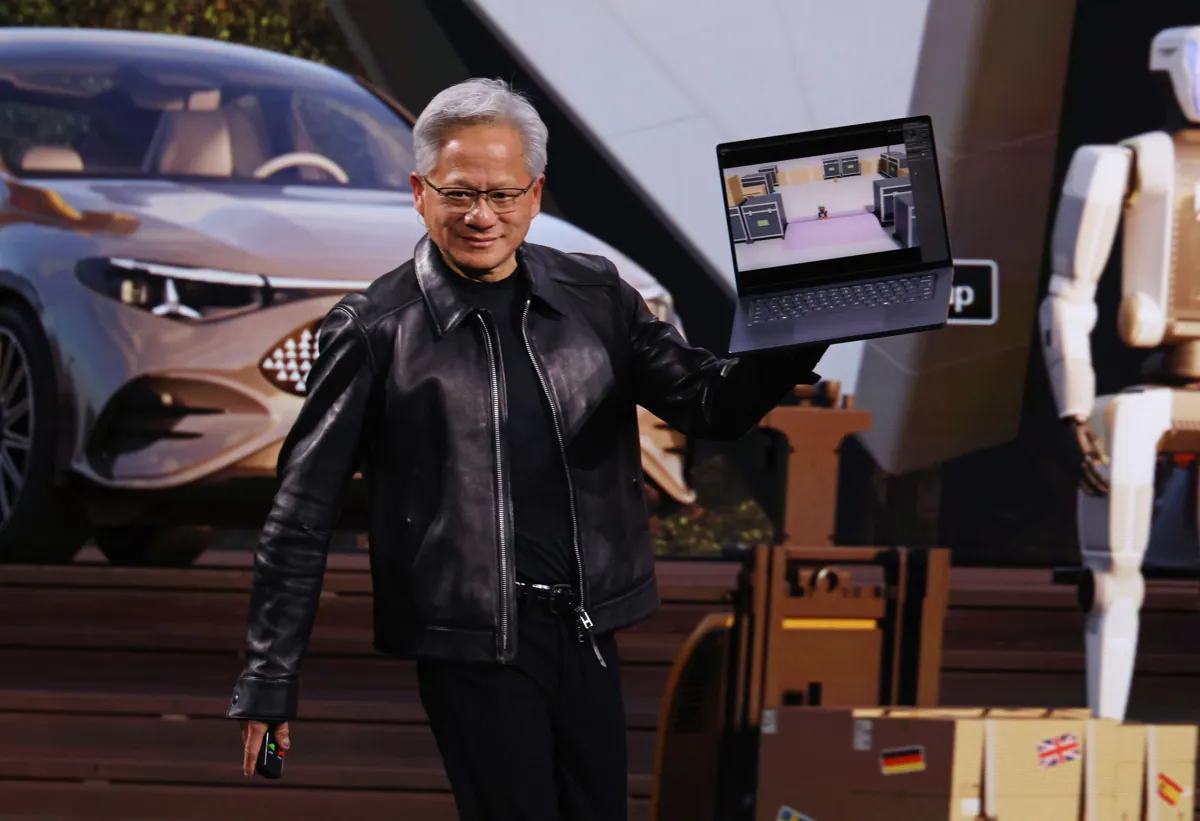
Jensen Huang wants Europe to stop merely using AI and start building it. At Nvidia's GTC conference in Berlin on Wednesday, the Nvidia CEO laid out a vision that leans heavily on robotics, autonomous software agents, and a new kind of data center that arrives, essentially, ready to plug in.
"To be part of this AI economy, you don't want to just be consuming the AI. You want to be producing the AI," Huang told the roughly 4,000 people packed into Berlin's Tempodrom, a circus-tent-shaped venue he filled with the lighting of a gamer's den. "We can do all of that here in Europe."
The headline announcement was something Nvidia is calling the DSX Pod, a modular "AI factory" that ships fully assembled inside a large metal container, loaded with the company's newest Vera Rubin compute racks. Instead of the months or years it typically takes to stand up a data center, Huang said a DSX Pod can be brought online in 14 days. He framed it as "a complete transformation" of how AI infrastructure gets built, and the pitch lands with particular force in Europe, where large infrastructure projects tend to crawl through permitting and construction timelines that make a two-week buildout sound almost absurd. Huang also argued the pods would cut down on idle compute time, since the hardware starts working almost as soon as it's delivered rather than sitting unused during a long construction phase.
From efficiency to physical AI
The shift in focus from Nvidia's last GTC, held in San Jose back in March, is notable. That event centered on AI inference and squeezing more efficiency out of compute. Seven months later, the conversation has moved to power, autonomous agents, and what the industry calls physical AI: systems that act in the real world rather than just generate text or images on a screen.
Robotics sits at the center of that pivot. Huang called humanoid robotics the "next great industry" and said Europe is particularly well positioned to lead it, pointing to the continent's manufacturing heritage as a natural advantage. To back that up, Nvidia announced a full-stack robotics platform meant to standardize how these systems are configured, plus a preconfigured reference robot called Agile One, which the company plans to make available to developers in the first quarter of next year as a starting point for building physical AI systems. "This is your great opportunity," Huang told the crowd.
But Huang was careful to note that physical AI isn't limited to humanoid robots. He pointed to telecom operators adding Nvidia GPUs directly to cell towers as another example of the same trend, computing power moving out of traditional data centers and into physical infrastructure. Nvidia also announced partnerships with European automakers Volkswagen and Mercedes focused on autonomous vehicles, extending the physical-AI theme into transportation.
Agents, open models, and the token math
On the software side, Huang predicted that companies will increasingly run both closed, proprietary AI models and open models they customize themselves. He pointed to Nvidia's own open-source models, which he said reach frontier-level performance once fine-tuned on an organization's own data, as evidence the open approach has caught up.
He also made a case for why AI agents, software that can reason, iterate, and use tools on its own, will expand rather than shrink the pool of people using software. More agents doing more complex work, in his telling, means more tokens consumed and more demand for the computing horsepower, namely Nvidia GPUs, needed to run it all. It's a familiar argument from Huang: more autonomy in AI systems translates directly into more Nvidia hardware sold, regardless of which layer of the stack you're looking at.
Circus tent, protesters, and a closing song
The 90-minute keynote swung between product pitches, including laptops, and sweeping claims about Nvidia's role as the foundational technology layer for essentially every industry. The event wasn't without friction: two Greenpeace protesters stood up mid-speech and unfurled a banner reading "Clean up your dirty business." Huang told his security team to "go easy" as the protesters were escorted out, according to Wired's account of the event.
The conference also featured robots: small Microduck units, built by Hugging Face, a company Nvidia recently acquired, performed on command at the close of Huang's presentation. And in case 90 minutes of technical detail hadn't fully landed, the keynote wrapped with an AI-generated Eurovision-style song recapping everything Huang had just announced.
The through-line across the pods, the robots, and the software predictions is the same one Nvidia has pushed at every GTC: whatever form AI infrastructure takes next, physical, autonomous, or modular, Nvidia wants to be the hardware underneath it. Whether Europe's manufacturing base and regulatory environment can move fast enough to capitalize on that pitch, especially with a two-week data center promise aimed squarely at the region's infrastructure bottlenecks, is the question worth watching as these pods and robotics platforms actually start shipping.


