Nvidia's Cutest Acquisition Yet: A Waddling Robot Duck Just Sold Out 20,000 Preorders
After Jensen Huang demoed the pint-sized robots at GTC Berlin, Hugging Face's Microduck became an unlikely hit — and a window into how Nvidia plans to make robotics feel approachable.
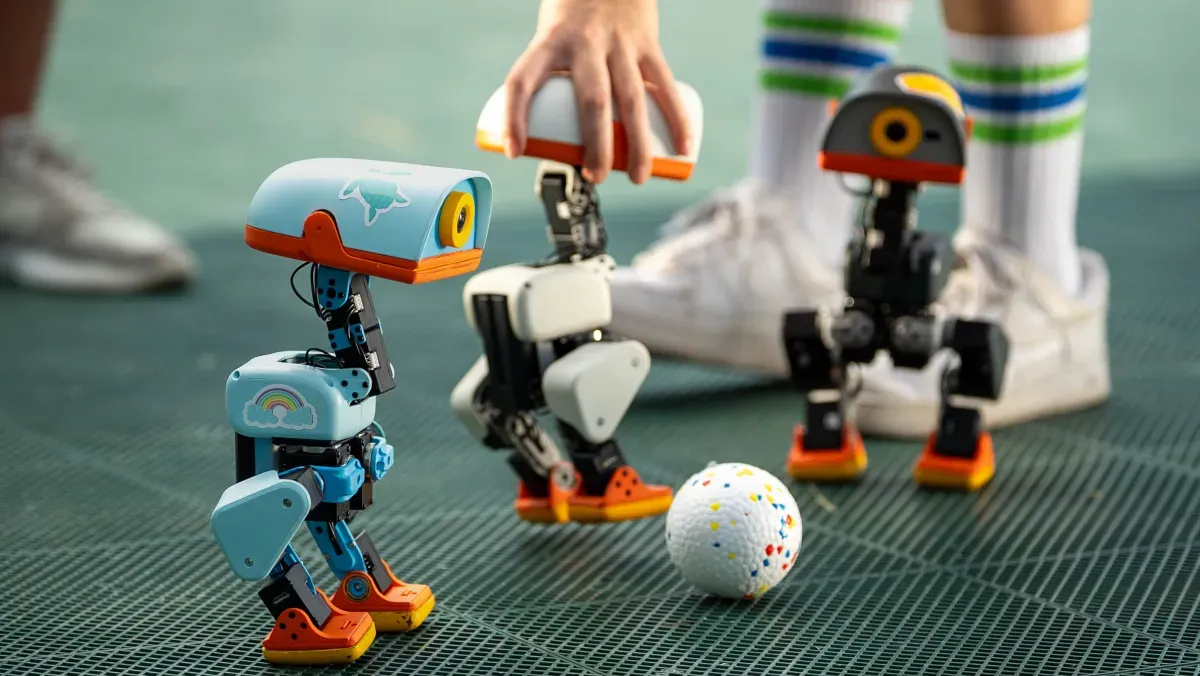
Nvidia CEO Jensen Huang spent part of his GTC Berlin keynote this week doing something he doesn't usually do on stage: playing with toys. A clip of him interacting with a group of Microducks — small robots that waddle, make R2-D2-style chirps, flop over for a "nap," and somersault on command — went viral almost immediately. Within a day, preorders had crossed 20,000 units, according to Hugging Face co-founder Clem Delangue, who shared the figure in a tweet.
The timing lines up well for Nvidia. Delangue said he expects the Microduck to ship in time for Christmas, and he's betting it could end up as the best-selling robot of the year. Notably, he doesn't think kids will be the only ones buying it. The promotional footage shows adults playing with the ducks too, which tracks with how the internet reacted to Huang's demo: less "neat robotics demo" and more "I need this."
Microducks come from Pollen Robotics, a French robotics company that Hugging Face acquired in 2025. That acquisition matters more than it might seem, because Hugging Face itself became part of Nvidia's orbit when the chipmaker bought the AI platform in September. So technically, the robot duck charming its way into holiday wish lists right now is an Nvidia product, even if nobody's marketing it that way.
This isn't Hugging Face's first attempt at a cute, approachable robot, either. The Microduck follows Reachy Mini, an earlier robot from the same lineage. The pattern suggests Hugging Face and Pollen are deliberately chasing a category that's been mostly absent from consumer robotics: small, likable, non-threatening machines that invite play rather than demand explanation.
Trained in simulation, built to be hackable
The technical story behind the Microduck is arguably more interesting than the cuteness factor. According to the source reporting, the ducks were trained using Nvidia's technology stack, with their basic repertoire — walking, sitting, standing, and the rest — taught through simulation before ever touching a physical duck body. That's standard practice in modern robotics: run thousands of attempts in a virtual environment, then transfer the learned behavior to real hardware.
What sets Microduck apart is that Pollen is positioning it as open-source and extensible. Owners aren't limited to the moves it ships with. Pollen says people can train their own ducks to learn new tricks and then share those behaviors with the broader community, turning a one-off toy purchase into something closer to an open platform. That's a meaningfully different pitch than most consumer robots, which tend to arrive locked down and finished.
Why Nvidia wants you to like a duck
Step back, and the appeal of the Microduck fits into a larger strategy Nvidia has been building. The company's ambitions in robotics and "physical AI" have been well documented, but most of that work has centered on industrial arms, humanoids, and simulation platforms aimed at researchers and manufacturers. A desktop toy that does backflips on voice command is a very different kind of outreach: it's robotics as something fun and ownable, not just something enterprise.
There's also a branding upside that doesn't require saying a word about chips or compute. Pollen's open-source, trainable design means enthusiasts who buy a Microduck for the novelty may end up tinkering with the same simulation-to-reality pipeline that underlies much more serious robotics work. That's a low-stakes, high-charm entry point into Nvidia's broader ecosystem.
The viral moment also landed at a convenient time. It arrived in a week when AI's public image took a hit, with reports tying AI involvement to a string of cyberattacks. A video of a robot duck napping on command and springing back up to somersault is, if nothing else, a reminder that the same underlying technology can produce something genuinely delightful.
Whether Microduck actually becomes the best-selling robot of the year, as Delangue predicts, will depend on how Pollen handles manufacturing and shipping at scale — 20,000 preorders overnight is a strong signal, but fulfilling a Christmas deadline is its own challenge. What's already clear is that Nvidia, almost by accident, has a mascot-grade product on its hands: a robot cute enough to make people forget, for a minute, that it's also a demonstration of the company's simulation and training stack.


