Google Vids Adds AI Avatars, Letting Workers Star in Their Own Corporate Videos
A selfie and a voice clip are now enough to generate a digital stand-in inside Google's Workspace video tool, as the company folds in its Gemini Omni model for prompt-based editing.
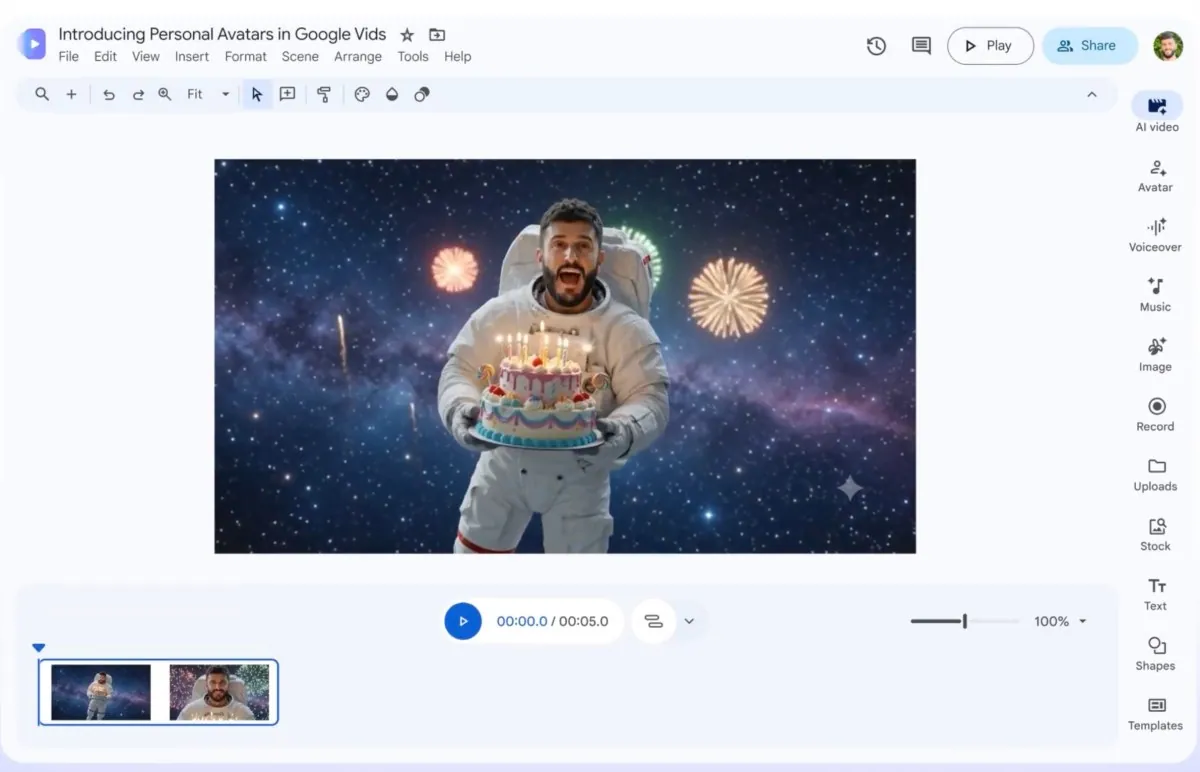
Google is giving its Workspace video tool a serious upgrade, and the headline feature is a little unsettling in a familiar way: upload a selfie and a voice recording, and Google Vids will build a digital avatar of you that can star in AI-generated videos on your behalf.
The company announced the update on Thursday. It lands at an odd moment, just as OpenAI's Sora, the buzzy AI video generator that let people insert themselves and others into surreal clips, has shut down. Google's timing suggests it sees a market that hasn't gone away, just moved.
Alongside the avatar feature, Google is bringing its multimodal AI model, Gemini Omni, into Vids. Multimodal means the model can work across different types of input at once, so in this case, users can combine a written prompt with their own reference images and let Omni blend them into a finished video. The same model can also handle more mundane fixes: swapping out a background, correcting bad lighting in a phone-shot clip, or layering in visual effects.
Google is also adding step-by-step editing to Omni, which lets users tweak a video incrementally rather than regenerating it from scratch every time they want a small change. That's a meaningful workflow shift for anyone who's used earlier generations of AI video tools, where even minor adjustments often meant starting over.
From presentation tool to full production suite
Vids launched as a Workspace feature aimed at helping employees put together polished presentations without needing video-editing chops. This update pushes it further, into something closer to a general-purpose AI video platform. Google is clearly still positioning it as a business tool, useful for things like internal company updates or employee training videos, the kind of content that used to require an actual production budget or at least someone who knew Premiere Pro.
But the addition of personal avatars and conversational, prompt-driven editing puts Vids on a collision course with a crowded field of AI video startups, including HeyGen, Synthesia, Captions, and D-ID, all of which have built businesses around letting companies generate talking-head videos without hiring an actual presenter.
Guardrails, sort of
Google is building in some limits that Sora, notably, did not have at launch. Avatars are tied directly to the account holder's own likeness and linked to their Google account, so you can't casually generate a video of, say, a coworker or a public figure without their participation. Every video also carries an invisible watermark using SynthID, Google's system for marking AI-generated content so it can be traced back to its origin later.
That's a pointed contrast with Sora's early days, when OpenAI CEO Sam Altman let users generate videos featuring his own likeness and others, leading to a wave of strange and viral clips. Don't expect the same treatment for Google's leadership; the account-tied structure and watermarking make that kind of free-for-all far less likely.
Access is also restricted for now. Google says personal avatars are only available to users 18 and older in select regions, a narrower rollout than a full global launch.
Why it matters
AI-generated video has moved fast from novelty to enterprise tool, and Google is betting that the version people actually want isn't a chaotic public plaground like early Sora, but something buttoned-up enough for a corporate intranet. By tying avatars to real identities and building the feature into Workspace, Google is aiming squarely at businesses that want AI-assisted video without the reputational risk of deepfake-style abuse.
Whether that caution costs Google some of the viral energy that made tools like Sora popular in the first place is an open question. But for the millions of people already living inside Google Workspace for email, docs, and meetings, Vids just became a much more capable place to make a video, and possibly the first place many of them ever generate one starring themselves.


