Google Turned On Its First Space Data Center Satellite — First Order of Business: Haiku
The Suncatcher prototype is now relaying data from orbit, part of Google's long-shot bet that AI computing will eventually move off the planet.
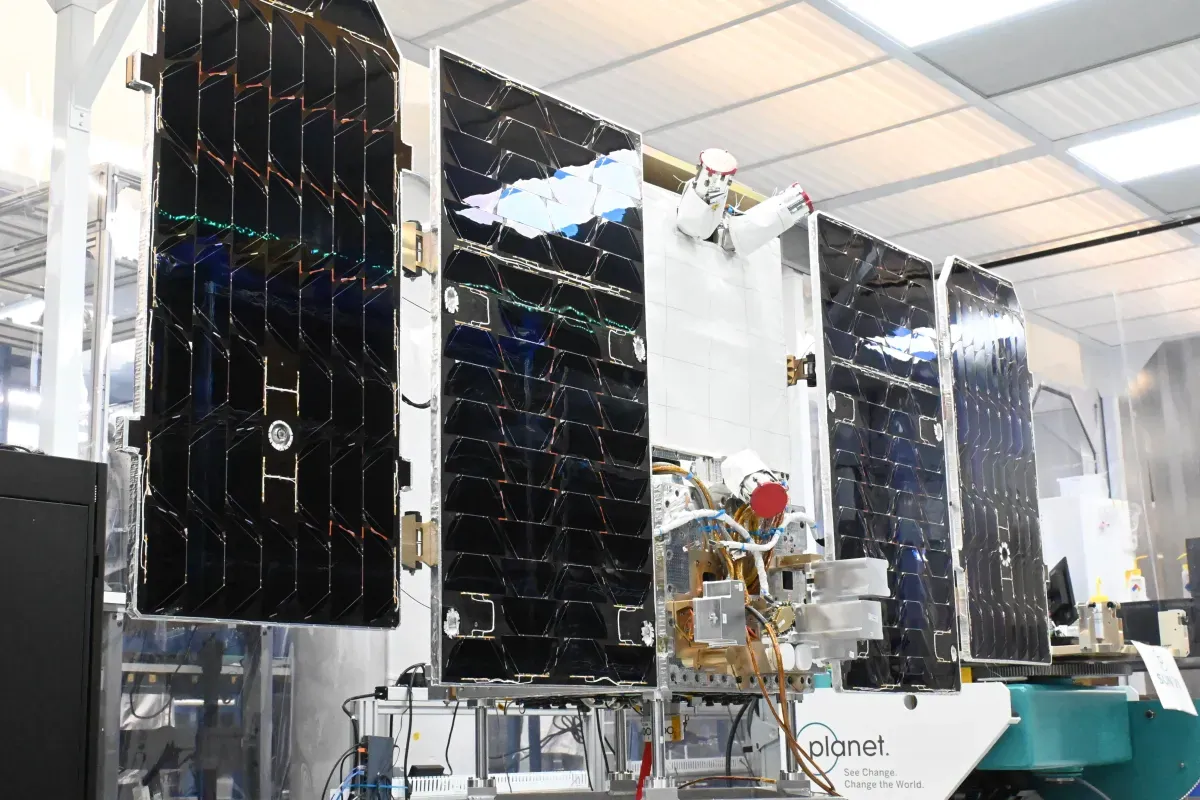
Google's first orbital data center is awake, talking to engineers on the ground, and apparently in a poetic mood. The prototype satellite, part of a project called Suncatcher, launched earlier this month on a SpaceX Falcon 9 alongside more than 100 other spacecraft. After roughly three weeks of commissioning to check out its systems, the team sent it a job: write a haiku about being in space.
The satellite, running Google DeepMind's Gemma 4 model on a single onboard Tensor Processing Unit (TPU), delivered:
Blue marble below Data streams in silent grace Starlight feeds my core. ✨
Cute, but the haiku was really a functional test. According to Google, engineers also had the satellite generate space-themed limericks and, more usefully, report on the orbital conditions around it. A Google spokesperson told TechCrunch the satellite is operating nominally.
The poetry is a sideshow. What Suncatcher is actually testing is whether it makes sense to run AI chips in orbit at all — and whether space itself will cooperate.
Why put a data center in space
The pitch behind Suncatcher is that satellites in the right orbit get continuous, intense sunlight, which could make solar power far more efficient than anything achievable on Earth. The catch is obvious: getting hardware into orbit is expensive, and once it's up there, you can't exactly send a technician to swap a part. Google's bet is that future fleets of satellites flying close together could handle large AI inference workloads — the computation involved in actually running a trained model, as opposed to training it in the first place.
This first satellite is a limited test of that idea. It carries just one TPU and generates up to 1 kW of power, which sounds modest because it is. The power draw is intense enough that the chip can only run for about 20 minutes at a stretch, according to Google. That's a real constraint, and it complicates something that's already difficult: getting data reliably between a satellite and the ground.
The radiation problem
The bigger open question is what space does to the hardware over time. Google has already run its TPUs through particle accelerators on Earth to simulate radiation exposure, but a simulation isn't the real thing. In orbit, cosmic radiation can cause what's known as a "bit flip" — a stray particle flips a stored value in a chip's memory, corrupting data in ways that don't necessarily trigger normal error alerts.
Google's ground testing suggested this effect would be minor for inference work, and more of a concern for training a model from scratch, which is far more computationally demanding and sensitive to errors. But that's a prediction based on simulated conditions. The current test campaign is designed to check whether real radiation and thermal stress in orbit match what Google saw on Earth, or whether space throws up surprises the lab couldn't.
What comes next
If the TPU holds up, Google plans to launch two more Suncatcher satellites in 2027, this time with more advanced chips, higher power generation, and — critically — optical links between the satellites. That inter-satellite laser communication is the piece that would let multiple satellites work together on a single workload rather than operating as isolated units.
That design choice sets Google apart from other players chasing the same idea. According to the report, Starcloud and Cowboy Space are planning to run inference on individual satellites without networking them together. SpaceX is also building toward laser-linked data centers, but its satellites are expected to orbit too far apart from each other to share processing work effectively. Google's Suncatcher is described as largely alone in aiming for satellites close enough, and connected enough, to run coordinated workloads as a single distributed system.
The SpaceX comparison isn't a coincidence. Alphabet, Google's parent company, holds a significant stake in SpaceX, and both companies' space data center ambitions depend on Starship — Elon Musk's heavy-lift rocket, still in development — becoming fully and rapidly reusable. Launch costs are the whole game here, and Suncatcher researchers published a peer-reviewed analysis this month estimating that SpaceX would need roughly 1,800 Starship flights to achieve the kind of cost reductions, driven by operational learning, that it saw with its earlier rockets. That's the scale of repetition needed before any of this becomes economically viable rather than an expensive experiment.
Suncatcher is, by Google's own framing, a long-term bet: infrastructure the company thinks could pay off in the 2030s, not next year. That horizon matters given the backdrop. The same week this satellite started phoning home, Alphabet's stock dropped after the company reported that pushing AI into its core search business is cutting into ad revenue growth. Suncatcher is a moonshot that depends on patient capital, and whether Google keeps funding decade-out space infrastructure may hinge on how well the rest of its AI strategy performs on much shorter timelines, right here on Earth.


