Hyundai Workers Walk Out Over Humanoid Robots Set to Join the Assembly Line
A breakdown in labor talks has triggered what may be the auto industry's first factory strike explicitly tied to humanoid automation.
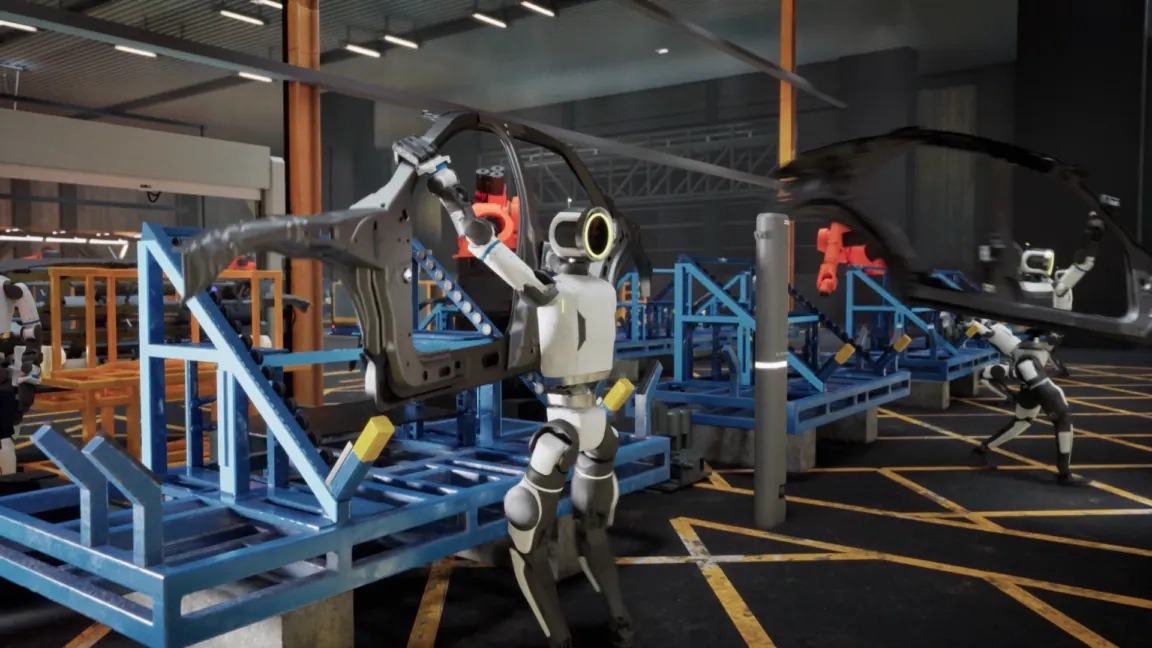
Thousands of unionized workers at Hyundai's massive Ulsan production complex in South Korea began cutting their shifts short this week, the opening move in a labor standoff that centers not on wages in the usual sense but on robots that walk on two legs and lift more than 100 pounds.
Talks between Hyundai and its union broke down after 15 rounds of negotiations, according to The Korea Times, prompting workers to end both day and night shifts two hours early from July 13 through July 15. The union plans to escalate further, staging four-hour strikes from July 20 to 22. The Wall Street Journal described it as the car industry's first factory stoppage explicitly addressing humanoid robots — a distinction that makes this dispute worth watching well beyond South Korea.
The trigger was Hyundai's unveiling earlier this year of the latest version of Atlas, the humanoid robot built by Boston Dynamics. Atlas stands more than 6 feet tall and can lift over 100 pounds, putting it squarely in the range of physical tasks currently done by human line workers. Boston Dynamics is in the process of becoming a wholly owned subsidiary of Hyundai Motor Group, tightening the automaker's grip on the robot that's now at the center of a labor fight.
A rollout measured in thousands
Hyundai's ambitions here aren't modest. The company plans to deploy more than 25,000 Atlas units across its own plants and those of sister brand Kia, according to The Korea Herald. The rollout is set to begin at US factories in 2028, though Hyundai hasn't said when or whether it will expand the program to plants elsewhere, including in South Korea.
The economics behind that plan are a big part of what's spooking workers. Samsung Securities Co. analyst Esther Yim told Bloomberg that each Atlas robot costs roughly $130,000 but could pay for itself within about two years of operation. Macquarie Securities Korea analyst James Hong went further, suggesting that if the per-unit cost eventually drops to $100,000, the robot's effective operational cost could fall below the US federal minimum wage of $7.25 an hour — undercutting what a typical auto worker earns by a wide margin.
That kind of math is exactly what labor unions have feared since automation first arrived on factory floors decades ago, except this time the automation doesn't look like a stationary robotic arm bolted to an assembly station. It looks like something built to move through the same physical space as a person, doing many of the same physical jobs.
What the union is asking for
The Hyundai Motor union, which represents more than 39,000 workers in South Korea, isn't simply demanding that Atlas be kept out of the plant. Instead, according to The Wall Street Journal, it's pushing for structural protections that would cushion the blow if humanoid robots start absorbing hours currently worked by people. Key demands include converting production workers from hourly pay to a fixed salary, so reduced work hours from automation don't directly translate into reduced paychecks, and raising the retirement age from 60 to 65. The union is also seeking larger bonuses for its members.
None of these asks are new tools in a labor union's playbook, but the reasoning behind them is distinctly of this moment. Fixed salaries insulate workers from the possibility that Atlas units quietly chip away at scheduled hours over time. A higher retirement age extends job security for older workers in an industry where physical automation could otherwise make experienced line workers redundant sooner than expected.
Why this matters beyond Ulsan
Humanoid robots have been a fixture of tech industry demos and investor pitches for the past couple of years, from Boston Dynamics to Tesla to a wave of well-funded startups. What's been mostly missing, until now, is a real-world instance of organized labor treating the threat as concrete enough to strike over. Hyundai's Ulsan complex is the world's largest automotive plant, and the fact that its workforce is willing to disrupt production over a robot that hasn't even been deployed there yet signals how seriously labor sees the coming shift.
The 2028 timeline for US deployment gives American autoworkers and their unions a preview of the same conversation, with Hyundai's cost projections offering a rough sense of the economic pressure that will eventually reach domestic plants too. If Atlas costs continue to fall as analysts expect, the pressure on wages and hours won't be limited to South Korea.
For now, the standoff in Ulsan is a negotiation over pay structure and retirement age, not a referendum on whether Atlas robots ultimately join the line. But it's the clearest sign yet that the debate over humanoid automation has moved from robotics conferences and boardroom slideshows into the place where it actually counts: the shop floor, and the paychecks of the people working it.


