The Boring Company Is Reportedly Raising $4 Billion at a $20 Billion Valuation
The tunneling startup's valuation would nearly quadruple its 2022 mark, even as it faces safety incidents and hundreds of environmental violations in Las Vegas.
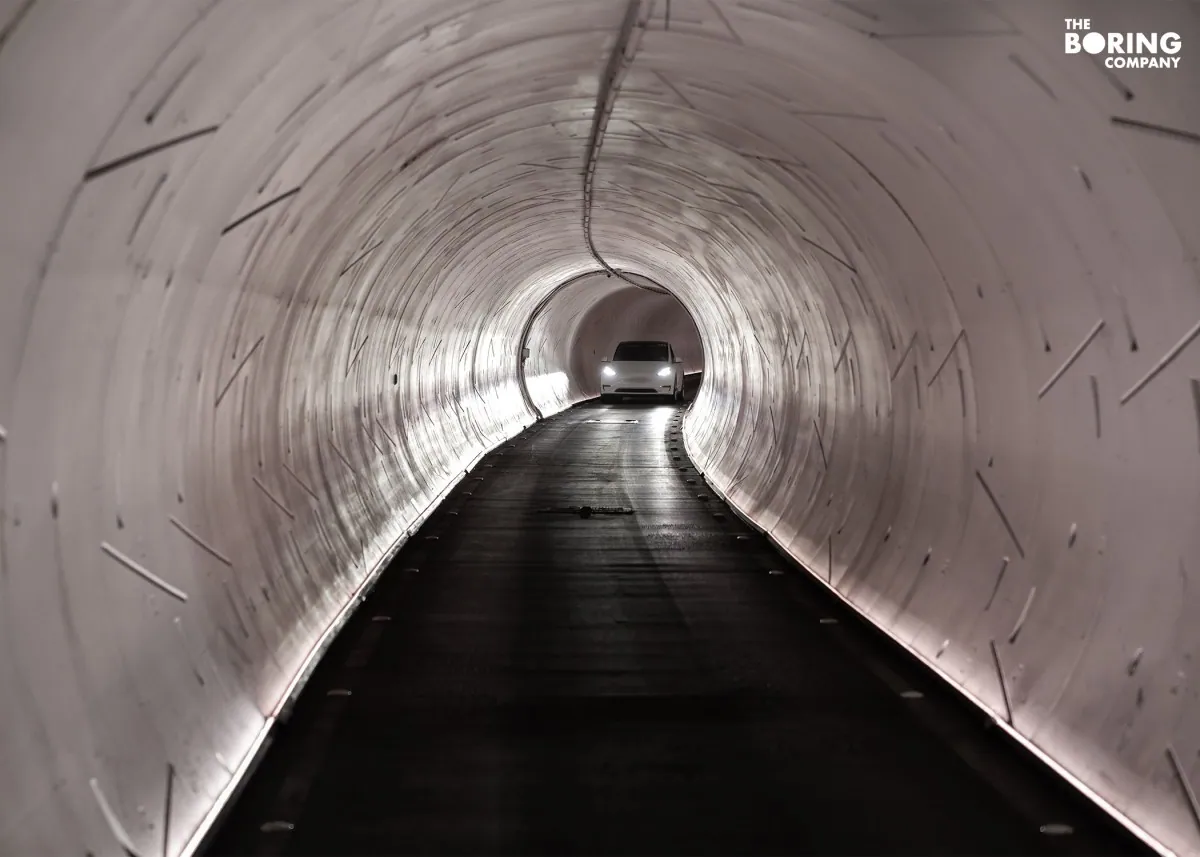
Elon Musk's tunnel-digging venture The Boring Company is in talks to raise $4 billion in fresh funding at a $20 billion valuation, according to a report from The Wall Street Journal. The deal isn't finalized, and the terms could still shift before anything closes, but the number alone marks a striking jump for a company that was valued at $5.7 billion back in 2022.
That would mean the valuation has more than tripled in roughly three years, for a company whose flagship product remains, at its core, a set of underground tunnels in Las Vegas that ferry passengers around in Teslas.
The Boring Company's Vegas Loop is its proof of concept: a network beneath the city where Tesla vehicles drive customers between stations, functioning as a kind of low-capacity, car-based subway alternative. It's the model Musk has pointed to as evidence that his tunnel-boring approach can work at scale, and the company has used it as the launching pad for pitches in other cities.
According to the Journal, The Boring Company has already announced plans to build tunnel systems under Nashville and Dubai, and it has pitched additional projects in Baltimore, Chicago, and Los Angeles. If even a fraction of those materialize, it would represent a major expansion beyond the single-city footprint the company has operated in for years.
But the business has real problems attached to it. Tunnel workers have suffered serious injuries on the job, and Nevada regulators found last year that The Boring Company violated environmental regulations nearly 800 times. Those aren't minor paperwork issues — regulatory violations at that scale, in the state where the company's only fully operational project exists, raise obvious questions about how the company handles safety and compliance as it tries to sell similar projects to new cities.
A SpaceX offshoot with its own trajectory
The Boring Company spun out of SpaceX in 2018, born from Musk's public frustration with traffic and his suggestion that digging under cities could solve it. Since then it has operated largely as one piece of Musk's sprawling portfolio of companies, alongside Tesla, SpaceX, xAI, and Neuralink, but it has carved out its own fundraising path and its own valuation story.
That story now sits at an interesting moment relative to its corporate parent. SpaceX recently completed the largest IPO in history, a milestone that underscored just how much investor appetite exists for Musk-founded ventures with ambitious infrastructure plays. But SpaceX's stock has dropped significantly since that debut, a reminder that massive valuations don't guarantee smooth sailing once shares actually start trading and investors get to reassess.
The Boring Company isn't public, and a private funding round at $20 billion doesn't carry the same immediate market scrutiny an IPO does. Still, the timing is notable: a fresh round of investor enthusiasm for a Musk company arriving right as another one, SpaceX, is showing that enthusiasm can cool fast once real trading begins.
What a $20 billion valuation is actually betting on
For investors, backing The Boring Company at this price means betting that tunnel infrastructure in Nashville, Dubai, and potentially Baltimore, Chicago, or Los Angeles can move from pitch deck to operating reality, and that the safety and regulatory issues seen in Las Vegas don't repeat or worsen as the company scales into new jurisdictions with their own rules and oversight.
It's also a bet on Musk himself continuing to command outsized investor interest even as his companies draw more public scrutiny over labor practices, safety records, and stock volatility. The Boring Company has spent years as the smallest and least visible of Musk's ventures next to Tesla, SpaceX, and xAI. A jump to a $20 billion valuation would put it firmly in the same conversation as the rest of his empire, at least in terms of the money flowing toward it.
Whether the round closes at that price, and whether the tunnel projects it's meant to fund actually get built, remains to be seen. The Journal's report makes clear the terms could still change before any deal is signed.


