NASA's Moon Lander Math Still Doesn't Add Up — and Neither Does Its Refueling Plan
SpaceX's Starship may need anywhere from six to 22 launches to land Artemis astronauts on the moon, and NASA's own mission graphic reveals a refueling choreography far more intricate than anyone expected.
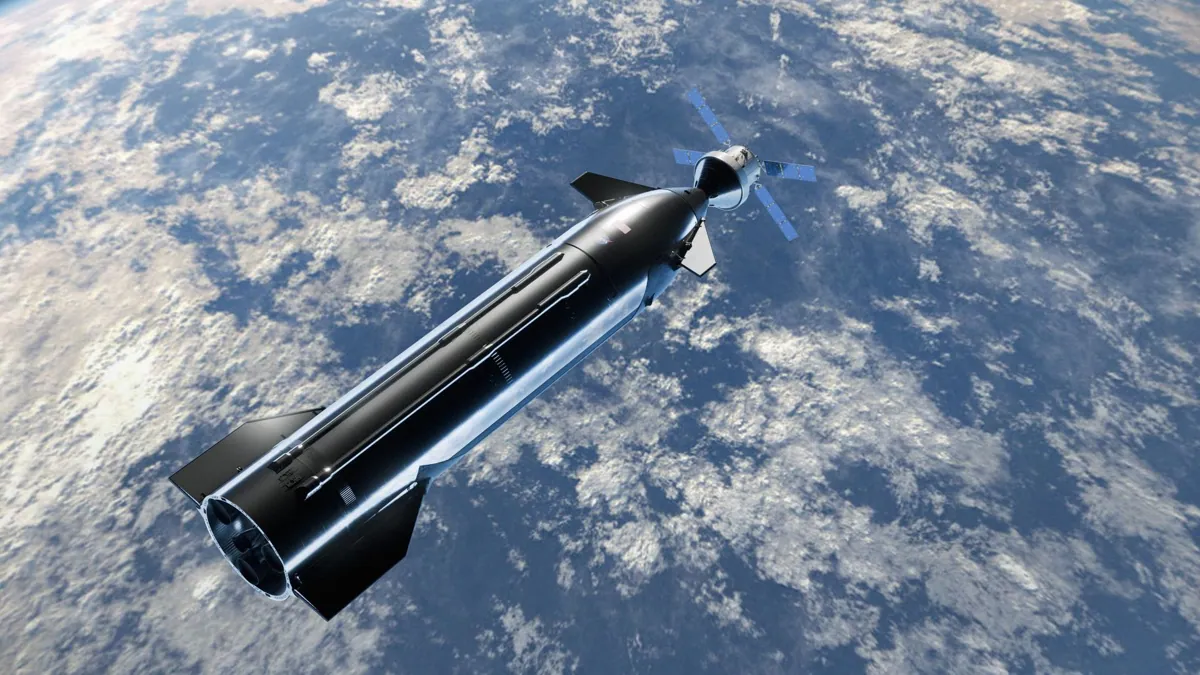
Nobody can agree on how many times SpaceX will need to launch Starship to get NASA astronauts to the moon. Six? Sixteen? Twenty-two? Depending on who you ask, the answer swings wildly, and a new NASA graphic detailing the Artemis IV mission suggests the refueling process behind that number is far messier than a simple launch count would imply.
Artemis IV is slated to be the program's first crewed lunar landing, and if SpaceX's Starship remains the lander of choice, it'll require an orbital refueling scheme that NASA itself has now mapped out in more detail than before. The short version: Starship doesn't just launch, gas up once, and head to the moon. It launches, docks with a fuel depot, moves to a different orbit, docks with the depot again, and only then heads off to meet the astronauts — all before the actual lunar landing even begins.
How many total launches that requires is still an open question, and the estimates floating around illustrate just how unsettled it is. Back in summer 2021, a Government Accountability Office audit pegged the number at up to 16 refueling flights. Earlier this month, a member of NASA's Aerospace Safety Advisory Panel suggested it could run as high as 22. Elon Musk, SpaceX's founder and CEO, shot that down almost immediately, posting on X that the real figure would land closer to six or eight.
That's a massive spread for a mission NASA is actively planning around, and it underscores how much of the Artemis IV architecture is still being worked out in public, launch by launch, estimate by estimate.
What NASA's graphic actually shows
Lost in the launch-count debate is a more granular question: where, exactly, does Starship refuel, and in what order? NASA's recent Artemis update graphic lays out the sequence, and it's considerably more elaborate than "launch, dock, go."
The mission starts conventionally enough. A Space Launch System (SLS) rocket carries the four Artemis IV astronauts aboard NASA's Orion capsule to high Earth orbit, where they rendezvous and dock with the Starship lunar lander. From there, Starship's engines burn to send both spacecraft toward the moon. Once they arrive in low lunar orbit, the two vehicles separate — two astronauts stay aboard Orion while the other two descend to the surface in Starship. After their time on the regolith, they launch back up, dock with Orion again, and head home. It's a sequence with clear echoes of the Apollo era.
But that straightforward crewed phase is only the back half of the mission. Before Orion ever rendezvous with Starship in high Earth orbit, Starship has to get fueled, and that process is where things get complicated.
According to NASA's outline, SpaceX will first launch a depot ship to low Earth orbit (LEO). That depot is essentially a fuel repository, and it gets filled by a series of tanker Starships — the graphic simply labels this step "(multiple)," meaning NASA isn't saying how many tanker flights it will actually take. Once the depot has enough propellant, SpaceX launches the Starship lunar lander to meet it in LEO for an initial refueling.
From there, Starship doesn't stick around. It undocks from the depot and climbs to a higher altitude NASA calls the "final tanking orbit," or FTO. Meanwhile, back in LEO, SpaceX launches yet another round of unspecified "(multiple)" tanker flights to refill the depot a second time. That depot then travels up to meet Starship in FTO for one more fuel transfer — the mission's actual final tanking, as the name suggests. Only after that second handoff does Starship head to high Earth orbit to finally meet Orion and the waiting astronauts.
So the sequence, step by step, looks like this: depot launches to LEO, gets filled by tanker flights, Starship lander launches and docks with it for a first refuel, Starship moves to FTO, the depot gets refilled again by another batch of tankers, the depot moves to FTO to meet Starship for a second refuel, and only then does Starship head to high Earth orbit to link up with Orion and the crew.
Why NASA says the complexity is worth it
It's a lot of moving parts for what, on paper, is "get the lander fueled." But NASA's explainer for Artemis IV argues there's a real purpose behind the staggered approach, beyond just procedural necessity.
For one, the multi-stage refueling gives NASA flexibility on when SLS actually launches Orion and the crew. Because Starship's fueling happens well before Orion gets off the ground, and because the lander has to make two separate stops at the depot, SLS's launch window isn't locked to Starship's exact fueling timeline the way a simpler one-shot refuel would be.
NASA also says the approach cuts down on overall fuel needs, partly because this plan sends Orion directly to low lunar orbit instead of the much higher orbit used in earlier mission concepts. Getting to a lower orbit changes the propulsion math in Starship's favor, even if it adds orbital steps along the way.
The number nobody can pin down
None of that resolves the central uncertainty: how many Starship launches, total, does an Artemis IV landing actually require? The gap between Musk's six-to-eight estimate and the safety panel's figure of up to 22 isn't a rounding error, it's roughly a fourfold difference in SpaceX's workload. And the graphic's two unspecified "(multiple)" tanker runs are exactly where that uncertainty lives, since nobody outside NASA and SpaceX seems to know precisely how many tanker flights each depot fill-up requires.
It's also worth remembering that Artemis IV's lander assignment isn't locked in. NASA could still turn to Blue Origin's Blue Moon lander if SpaceX can't demonstrate its orbital refueling strategy works, or if it fails to pull off an uncrewed lunar landing demonstration by the end of next year — assuming Blue Moon can meet its own requirements in time.
Whichever company ultimately lands Artemis astronauts on the moon, the operational details of how their hardware actually gets there should sharpen considerably as the mission's launch date approaches. For now, the refueling math behind Starship's path to the moon remains one of the program's most stubborn open questions, and NASA's own choreography for Artemis IV only highlights how many steps are still unresolved between here and the lunar surface.