Anthropic Brings Claude's Voice Mode to Its Smartest Models
The upgrade lets users talk through complex work problems with Opus and Sonnet, not just fire off quick questions to the lighter Haiku model.
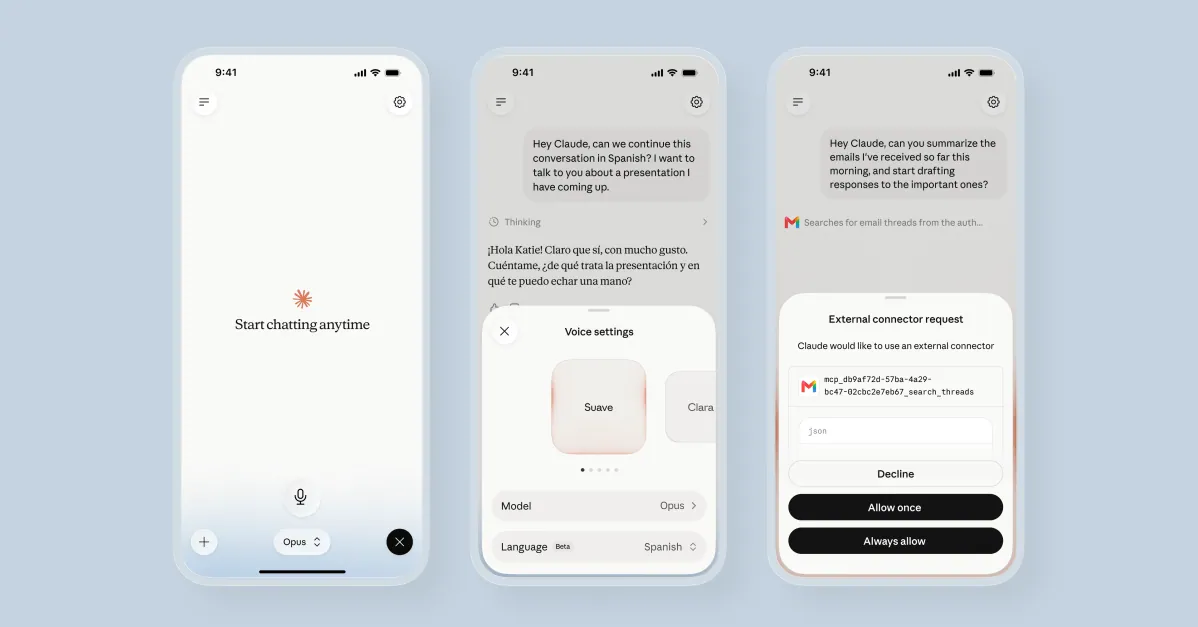
Anthropic is giving Claude's voice mode a serious upgrade. Until now, talking to Claude out loud meant talking to Haiku, the company's fastest but least capable model. Starting now, users can also access Opus and Sonnet in voice mode, along with deeper connections into everyday apps like Gmail, Slack, and Canva.
The change comes down to a mismatch Anthropic noticed between how it built voice mode and how people actually used it. When the feature launched earlier this year, it was designed for speed: ask a quick question, get a quick answer, minimal lag. Haiku was the natural fit for that job. But according to Anthropic's blog post announcing the update, people quickly started pushing voice mode into territory it wasn't built for, working through what the company called real business problems out loud. Haiku, in Anthropic's own words, "kept conversations quick, but not always deep."
Opus and Sonnet solve that mismatch. Anthropic describes them as models built for harder problem-solving, capable of more complex reasoning and analysis, and of following through with actual tasks rather than just conversation. The company's examples give a sense of what that looks like in practice: talk through an idea out loud and have Claude turn it into a one-page pitch document, or mention that your train is delayed and have it rearrange your calendar accordingly.
That's a meaningfully different use case than the original pitch for voice mode. Quick Q&A is a convenience feature. Working through a business problem, drafting a pitch, or managing a schedule is closer to having a functioning assistant, and it requires a model that can hold context, reason through nuance, and act on your behalf rather than just respond fast.
Switching models mid-conversation
One of the more practical additions here is flexibility. Users can move between text and voice mid-conversation, and switch models on the fly, too. Anthropic's framing: if a fast back-and-forth with Haiku surfaces an interesting idea, you can carry that conversation over to Opus to dig in further, without starting over or losing the thread. That kind of fluid handoff between a lightweight model and a heavyweight one is a fairly practical acknowledgment that different parts of a task genuinely call for different tools, and that forcing users to pick one model for an entire session doesn't match how people actually think through problems.
The expanded app integrations point in a similar direction. Voice mode now reaches into Gmail, Slack, and Canva, which suggests Anthropic is positioning Claude less as a standalone chatbot and more as a voice-driven layer that sits on top of the tools people already use for work. Combined with the ability to take action, like rescheduling based on a spoken comment, the update pushes voice mode further from "answer engine" and closer to "assistant that gets things done."
More languages, wider reach
Anthropic also used the update to broaden voice mode's language support. Previously, anything beyond English was still in beta. Now voice mode is fully available in French, German, Spanish, Hindi, Indonesian, Italian, Japanese, Korean, and Portuguese, according to the company. That's a notable jump in reach for a feature that, until now, was effectively an English-first product still finding its footing elsewhere.
Taken together, the update reflects a pattern that's become familiar across the AI industry: companies ship a feature with one use case in mind, watch users bend it toward something more ambitious, and then rebuild the feature to match. Anthropic built voice mode for quick answers and found people wanted a spoken interface to actual work. Giving Opus and Sonn`et voice access, letting users hop between models mid-task, and wiring voice mode into Gmail, Slack, and Canva all read as a direct response to that gap.
What's worth watching next is whether Anthropic keeps extending voice mode's reach into more third-party apps, and whether other AI companies follow the same trajectory: launching voice as a lightweight convenience, then rebuilding it once users start treating it as a real interface for work.


