Google and Meta's Pacific Cables Flagged as Top Targets in New Sabotage Risk Report
A congressional advisory commission's new vulnerability index maps which undersea cables face the highest exposure to Chinese "gray zone" tactics, and US tech giants' infrastructure tops the list.
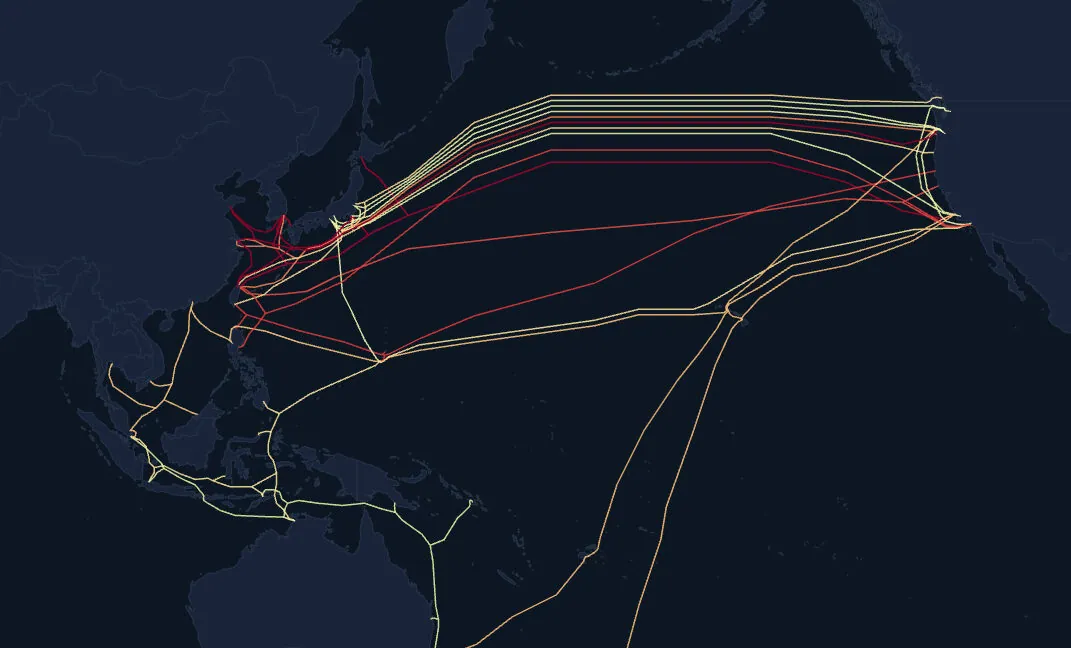
Undersea cables owned by Google and Meta rank among the most exposed to potential sabotage in the Pacific, according to a new risk assessment that arrives alongside growing evidence of Chinese ships lingering suspiciously close to the Internet's physical backbone.
The report, published in September 2026, comes from the China Strategic Risks Institute, a London-based think tank commissioned by the US-China Economic and Security Review Commission, an independent body that advises Congress. It lands at a moment when Chinese research vessels have been spending unusual amounts of time near subsea cable routes, ostensibly surveying the seafloor, while separate incidents involving Chinese commercial ships have drawn scrutiny for cutting cables in both European and Asian waters, according to the report.
Most cable damage worldwide is mundane. Bottom-trawling fishing nets snag lines, ship anchors drag across the seabed, storms and underwater landslides do their damage. That's been true for decades. But rising geopolitical tension has put a sharper lens on incidents that look less accidental, and analysts have increasingly flagged both China and Russia for using cable interference as a so-called gray zone tactic, pressure applied below the threshold of outright military conflict.
A map of who's exposed
The centerpiece of the new report is an interactive tool called the Trans-Pacific Cable Gray Zone Vulnerability Index, which ranks individual undersea cables by risk and plots their routes across the Pacific. The idea is practical as much as analytical: a ranking like this could help governments and cable operators decide where to prioritize countermeasures, whether that means installing underwater sensors or stepping up naval patrols along the most vulnerable stretches.
The index weighs several factors to arrive at its rankings. How deep underwater a cable sits matters, since deeper cables are harder to reach but also harder to monitor. Nearby shipping traffic density is another input, given how much accidental and potentially deliberate damage originates from vessels operating above the cable routes. The report also accounts for who owns each cable, whether a route passes through China's exclusive economic zone or falls within its broader territorial claims, and whether the cable connects to Taiwan.
That last factor carries particular weight. Taiwan is a self-governing democracy that Beijing claims as its own territory, and China has escalated military activity around the island in recent years, including warship and aircraft maneuvers. Any cable linking to Taiwan sits at the intersection of commercial infrastructure and one of the world's most closely watched flashpoints.
Why Google and Meta show up near the top
Both companies have poured money into their own subsea cable systems over the past decade, moving away from relying solely on shared consortium cables to build dedicated routes that carry their own cloud and platform traffic across the Pacific. That ownership stake is exactly the kind of factor the new index tracks, and it's part of why infrastructure tied to the two companies ranks among the most exposed in the assessment, according to the report.
It's a reminder that the cables carrying search queries, video calls, cloud backups, and nearly everything else that moves across the Pacific aren't abstract. They're physical lines sitting on the ocean floor, owned by specific companies, following specific routes that can be mapped, studied, and in theory targeted.
The bigger picture
None of this means a cable-cutting campaign is imminent. The report is a risk assessment, not an incident report, and the vast majority of cable damage historically traces back to fishing gear and anchors rather than anything resembling sabotage. But the pattern the think tank describes, with Chinese research ships spending extended time near cable corridors and Chinese commercial vessels under investigation for cable-cutting incidents elsewhere, adds weight to warnings that have circulated among security analysts for a while now.
For a commission that exists to advise Congress on economic and security matters tied to China, publishing a tool that pinpoints exactly which pieces of American tech infrastructure sit in the riskiest spots is itself a signal. It gives policymakers, and the companies that built this infrastructure, a concrete starting point for deciding where to invest in protection rather than treating the entire Pacific cable network as a uniform, abstract risk.
What happens next likely plays out away from headlines, in decisions about where to park sensors, reroute patrols, or route future cable builds around the most exposed corridors identified in the index.


