Boston Dynamics Sends Atlas and Spot to the World Cup — One's Learning Trick Shots, the Other's Patrolling Stadiums
Hyundai's robotics arm is using soccer's biggest stage to show off reinforcement learning breakthroughs in its humanoid Atlas, while Spot quadrupeds quietly work security at U.S. venues.
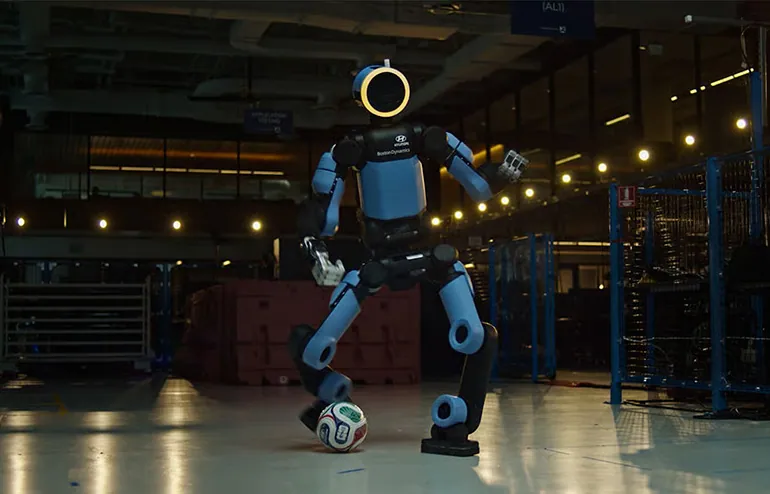
Boston Dynamics has found an unusual proving ground for its robots this year: the FIFA World Cup. The company's Atlas humanoid has learned to perform a soccer trick shot, and its four-legged Spot robots are walking security rounds at tournament stadiums in the U.S., according to interviews the company gave to The Robot Report.
The work comes through Hyundai Motor Co., which bought Boston Dynamics in 2021 and has held a partnership with FIFA for 27 years. Rather than entering its robots into competitions like RoboCup, where humanoid robots actually play matches against each other, Hyundai chose to keep humans on the field and instead use the tournament to demonstrate what its robots can learn and do in the real world.
Teaching Atlas to kick like a pro
The centerpiece is something Boston Dynamics calls the "Ghost Rabona" — a kick modeled on one of soccer's more famous trick shots, developed for a campaign called "School of Football." Alberto Rodriguez, the company's director of robot behavior, told The Robot Report that Hyundai pitched the soccer-themed campaign and the timing lined up well with a new generation of Atlas.
"Soccer has extreme behaviors, and the time was right to challenge the new generation of Atlas to do things like imitate the iconic trick shots of leading players," Rodriguez said.
What makes the kick harder than it looks, according to Rodriguez, isn't the athleticism itself. Boston Dynamics has already had Atlas doing flips and jumps for years. It's the interaction between the robot, a ball, and the ground that's genuinely difficult — coordinating footwork, contact, and friction is a more complex problem than a backflip.
To get there, the team leaned on motion capture and simulation. Engineers put a skilled soccer player in a mocap suit, recorded the movement, and fed that data into a simulation engine. From there, reinforcement learning — a training method where an AI improves through trial and error rather than being explicitly programmed — took over, generating a working policy for Atlas in a matter of hours to a day.
That's a significant shift from how Boston Dynamics used to operate. Rodriguez said that about a year ago, the company had what he considers the best predictive-control system in the world for humanoid balance, built on years of work on athletic behavior. It scrapped that approach in favor of reinforcement learning. The payoff, he said, is that RL lets Atlas do things that would be nearly impossible to hand-program or demonstrate directly — like the robot carrying a fridge, a capability that also underlies more mundane tasks like carrying boxes in a warehouse.
Building Atlas for this kind of learning also meant simplifying it mechanically. Rodriguez said the robot uses rotary actuators instead of linear ones specifically because they're easier to simulate and manufacture, which makes the whole simulate-then-deploy pipeline work better.
Soccer still threw the team a real engineering curveball: grass. Rodriguez said turf is far more compliant than the concrete or plywood surfaces the company usually tests on, and that compliance wasn't well represented in the simulation engine. On real grass, a robot's foot can sink, slip, or catch on the turf, so the control systems had to become more robust to unexpected footing and to react with lower latency to avoid tripping. Rodriguez said those improvements are now baked into all of Atlas' behaviors and should translate into more reliable stepping across different industrial terrains.
He was clear about the limits, though. Atlas isn't close to doing what an actual soccer player does — reading other players, moving safely at speed around people. "The technology isn't there today," he said.
Spot's night shift: stadium security, not a photo op
While Atlas performs, Spot is doing quieter, less flashy work. The four-legged robot is patrolling stadiums in the U.S. as part of World Cup security operations, according to Merry Frayne, Boston Dynamics' senior director of product for Spot. The robots are deployed at two venues in Dallas and two at Citi Field.
Frayne was direct about the nature of the job: "Spot is a working dog — it's not a photo op." The robots walk designated routes looking for hazards or suspicious packages, largely during off-hours when stadiums are empty. They can run autonomously, following mapped routes, or be teleoperated by the security teams who actually control them — Boston Dynamics' role is limited to helping those teams get the systems set up.
The robots aren't equipped with facial recognition. Instead, they carry a sensor suite Boston Dynamics calls Spot Cam: a 360-degree camera on the front, 4K and high-definition imaging, thermal cameras, and lidar for autonomous navigation.
Security is a relatively new use case for Spot, which has mostly been deployed for industrial inspection — checking pipelines, mines, and nuclear facilities for leaks, sagging equipment, or anything else out of the ordinary. Frayne said the jump to stadium security hasn't required much modification, since the underlying task of monitoring an environment and flagging anomalies is similar. What's different is the setting: stadiums are built for people, which Frayne said opens up possibilities that industrial sites, built for machines and processes, don't offer.
Spot's public profile has been more novelty than utility at times — the robot performed on America's Got Talent last year — and Frayne acknowledged that balancing whimsy with serious work is part of the strategy. Getting people comfortable seeing robots operate around them, she argued, matters as much as the technical capability itself.
What comes next
Beyond the World Cup, Boston Dynamics is expanding Spot into new partnerships. Frayne mentioned Path Robotics as a collaborator on welding applications and said the company is building interactive capabilities for circuit-breaker racking — the kind of maintenance task found in data centers and other complex industrial builds. Spot is also being used by first responders and labs, including work related to detecting and disposing of munitions. Frayne said Boston Dynamics plans to announce additional markets for the robot in the coming months.
Taken together, the World Cup appearances function less as a stunt and more as a public demonstration of two different bets Boston Dynamics is making: that reinforcement learning can push humanoid robots toward genuinely novel physical skills, and that legged robots like Spot can quietly earn a place in everyday infrastructure by doing unglamorous, useful work well.


