Google Lets Any Developer Plug Into Gemini and Search's AI Agents
A new Connected Apps Platform opens the door for businesses to make their services actionable inside Google's AI products, not just findable by them.
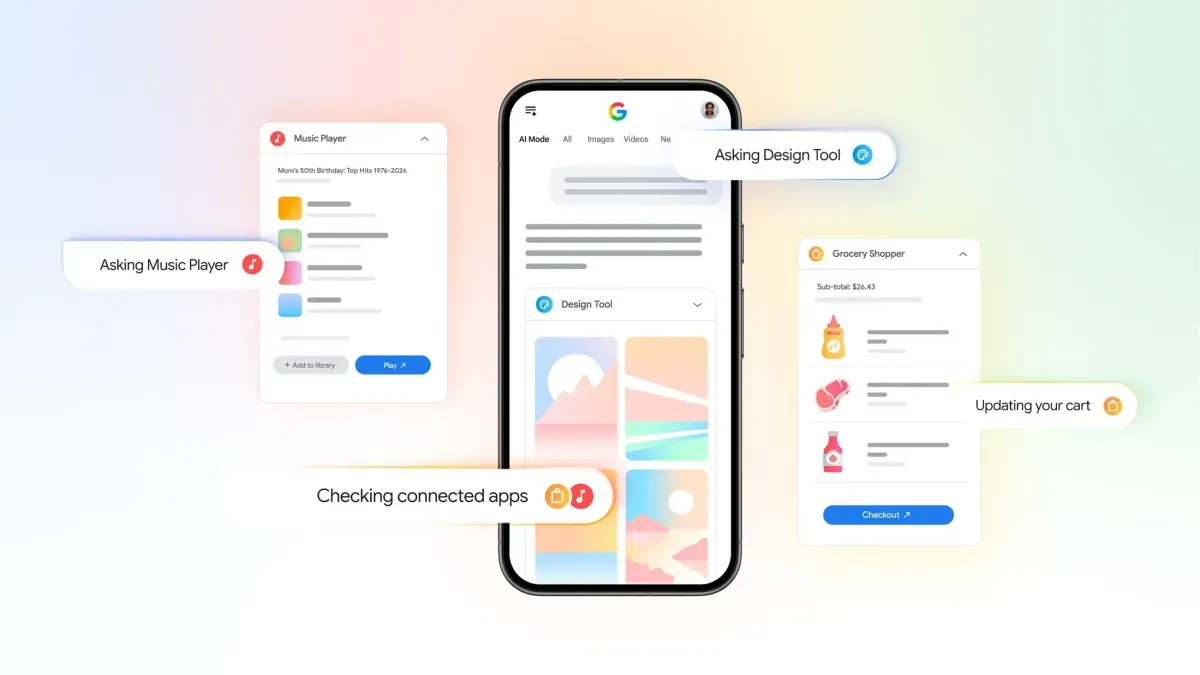
Google wants every app on the internet to have a seat at the table in Gemini and Search, and it's building the plumbing to make that happen. The company this week introduced its Connected Apps Platform, a system that lets any business or developer submit their own app for use inside Google's AI products, rather than waiting for Google to strike a partnership deal first.
Connected apps aren't new. Google rolled out the feature in Gemini and Search earlier this year, letting users link accounts from services like Canva or YouTube Music and then actually do things with them through the AI, like designing a flyer or building a playlist, instead of just getting a link to go do it themselves. What's new is the on-ramp. Until now, getting your app into that lineup meant being one of Google's chosen partners. The Connected Apps Platform turns that into a self-service process, currently in beta for developers in the U.S.
The mechanics matter here. According to Google, developers integrate their app with a cloud-hosted MCP (Model Context Protocol) server, or an Android MCP using the AppFunctions APIs, and then use a tool called the Google Connected Console to register, test, and submit the app. From there, they can choose whether it shows up in Search, the Gemini app, or both. Once live, developers get dashboards for traffic, latency, and error rates, plus control over how their brand appears, including verified logos and authenticated accounts.
That last detail is worth sitting with. It signals Google isn't just building a feature, it's building infrastructure with the kind of observability and brand controls you'd expect from an ad platform or app store, not a chatbot plug-in.
Why this looks like the next SEO
The comparison Google itself is inviting is to search engine optimization. For two decades, showing up in Google's search rankings was existential for businesses, and an entire industry formed around gaming, understanding, and optimizing for it. If AI agents become the primary way people discover and use services, then getting your app registered and functioning well inside Gemini and Search could become the next version of that fight for visibility, except this time the prize isn't a blue link, it's an agent actually completing a task on a user's behalf.
That's the bigger bet behind connected apps generally: that people will increasingly ask an AI assistant to just handle something, rather than opening five different apps to do it themselves. Google isn't alone in testing that idea. ChatGPT and Meta's Muse have both experimented with their own versions of letting AI tools reach into third-party services. But the strategy only works if there's enough on the other side of the integration to make it worth a user's time. A platform with a handful of partners is a demo. A platform with hundreds of app integrations starts to look like a genuine alternative to the app drawer on your phone.
The current roster, and what's coming
Google says Gemini already has more than 50 connected apps live, from partners including Adobe, Experian, Localiza, and Peloton, layered on top of Google's own stable of services like Workspace, Photos, YouTube Music, and Google Home. Search has lagged behind, with a shorter list that includes Instacart, Canva, YouTube Music, and Yahoo Fantasy Football. Google says that gap is about to close, with Gemini's existing roster of apps expanding into Search over the coming weeks.
There's also a fresh name joining the mix: meditation app Calm, which Google says will launch on both Gemini and Search soon as part of this push.
For now, the Connected Apps Platform itself is limited to a waitlist for U.S. developers, and Google hasn't said when it'll open more broadly or to other regions. That's a reasonable amount of caution for a system that effectively hands third parties a direct line into how Gemini and Search behave on a user's behalf. Quality control, security review, and brand verification all take time to get right, especially when the end result is an AI agent taking real-world actions like making a purchase or building a document, not just returning a search result.
What happens next is really a question of adoption speed. If enough developers see connected status as the new must-have, the way getting indexed by Google once was, this could reshape how businesses think about their relationship with the search giant entirely. If it stays a novelty used by a few dozen partners, it's just a feature update. Google is clearly betting on the former, and it's now opened the gates to find out.


