Apple's Trade Secrets Lawsuit Against OpenAI Is a Fight Over Who Owns What Comes After the iPhone
The Verge's Hayden Field and Nilay Patel unpack why Apple's allegations against OpenAI's hardware team could be more dangerous for Sam Altman's company than it looks.
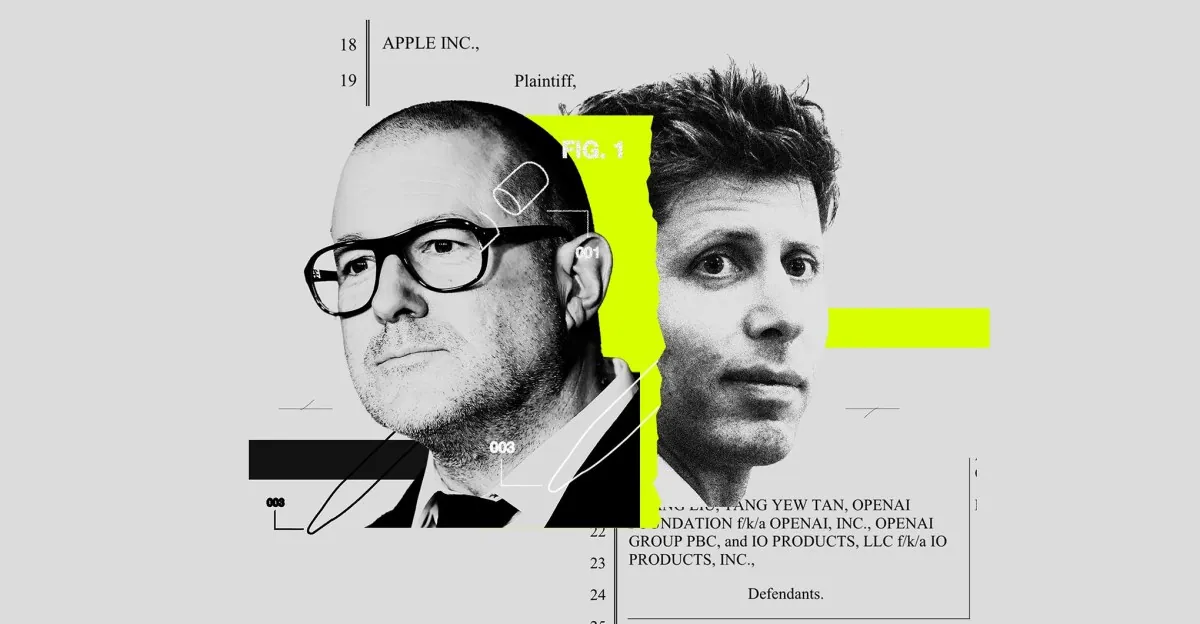
Apple's new lawsuit against OpenAI reads like a corporate thriller: former Apple employees allegedly grilling job candidates about secret hardware projects, workers reportedly asked to sneak prototype components out of Apple offices for "show and tell" sessions, and a text message — cited in the case — from someone who'd apparently just accessed confidential Apple files gloating, "LOL! So funny that I can access this."
But according to Hayden Field, The Verge's senior AI reporter, the shock value of those details obscures a more interesting question: whether OpenAI, unlike the giants Apple has sued before, can actually survive a legal fight like this one.
Field discussed the case on The Verge's Decoder podcast with editor Nilay Patel, drawing on her own reporting and interviews with intellectual property lawyers about how seriously to take Apple's claims. Her conclusion, in short: the specific allegations aren't unusual for trade secrets litigation, but the scale and the players involved are. "We see this all the time with trade secrets cases," Field said lawyers told her. "What's really crazy is that it's all in one case and that it's two really large companies."
A familiar Apple playbook, aimed at a much less stable target
Patel points out that this is the third time in roughly three decades that Apple has pushed a major area of intellectual property law to its limits in a fight with a rival. In the 1990s it was copyright, when Apple sued Microsoft over the look and feel of Windows. In the 2000s and 2010s it was patents, when Apple went after Samsung over Android and Galaxy phones — a fight that eventually produced roughly $1 billion in damages paid by Samsung but didn't stop Android from becoming a dominant mobile platform. Now it's trade secrets, and OpenAI is on the receiving end.
The difference this time, Field and Patel argue, is that OpenAI isn't Microsoft or Samsung. Those companies had the balance sheets to absorb years of litigation and, in Samsung's case, treat a $1 billion penalty as the cost of breaking into mobile. OpenAI is still burning cash, preparing for an IPO, and under pressure from investors to show a path to profitability. A long, expensive legal battle with Apple is a very different proposition for a company in that position than it was for Samsung in its prime.
Tang Tan, not Jony Ive, is the central figure
Much of the public conversation about this case has focused on Jony Ive, Apple's famed former design chief, who sold his hardware startup io Products to OpenAI for $6.5 billion in 2025 and has since appeared in a widely memed video with Sam Altman describing the phone and laptop as "legacy devices." But Ive isn't named in Apple's lawsuit at all.
The figure Apple's complaint centers on is Tang Tan, who spent 24 years at Apple, most notably as vice president overseeing the Apple Watch, before leaving in 2024 to join io Products and later becoming OpenAI's chief hardware officer. Bloomberg's Mark Gurman has reported that Tan had a reputation at Apple for "playing fast and loose." According to Apple's claims, Tan allegedly used his knowledge of secret, code-named Apple projects during job interviews to draw out proprietary information from candidates who assumed he must already have clearance to know it, and allegedly asked some interviewees to bring hardware components out of Apple's offices for demonstrations.
Field speculated that Ive's absence from the suit may simply reflect that he operates at a level where others carry out the riskier work. "I really feel like it's just that he has other people doing his dirty work for him," she said, adding that if Apple had found damaging material tied to Ive directly, it seems unlikely the company would have left it out given how much other detail made it into the filing.
Why OpenAI needed Apple's people in the first place
The larger context here is OpenAI's ambition to build consumer hardware, reportedly as many as five separate devices, starting with a screenless smart speaker. Field and Patel both note the obvious risk: AI hardware has a rough track record, and no one wants to become "the next Humane AI Pin," a reference to the widely mocked wearable that flopped after launch.
Hiring experienced hardware executives from Apple is, in that sense, a defensible strategy regardless of the trade secrets allegations. Hardware doesn't allow the kind of rapid pivoting that's possible with software, where a company like OpenAI can quietly shut down underperforming features. Get a physical product wrong and there's no quiet fix.
But Patel raises a deeper skepticism about whether any of this hardware push makes sense right now. Drawing a comparison to the early smartphone era, he notes that consumer adoption of the iPhone was never really in question, only which company would end up dominating. AI hardware doesn't have that same inevitability. Field agrees that mainstream adoption is far from guaranteed, pointing to the social dynamics that drive device adoption. People buy what their friends already have. A standalone AI gadget doesn't yet have that pull.
Central to both the hardware bet and the lawsuit itself is the unresolved question of whether current AI models are reliable enough to be trusted with something like a voice-first device with no screen. Field described testing an AI tool to compile a list of company addresses and finding that roughly 60 percent of the results were wrong, despite the system's confident assurances that everything checked out. That kind of failure rate matters more on a device meant to handle real tasks, like flight times or scheduling, than it does in a low-stakes chatbot exchange.
The bigger irony hanging over the whole industry
Field and Patel connect the Apple case to a broader pattern across the AI industry: businesses built substantially on data and material obtained without explicit permission, whether that's training data scraped from the web, or, as Field notes, the recent revelation that AI music company Suno had scraped copyrighted material from YouTube without authorization. Apple's allegation that OpenAI took its hardware and manufacturing know-how without permission fits, in Field's view, a recognizable pattern.
Patel points out a particular irony: AI companies that built their models on freely taken data are often the loudest voices objecting when competitors, including Chinese AI labs, use distillation techniques to replicate their own models' capabilities. Field said she hasn't seen anyone in the industry publicly connect those two positions, even as AI labs write open letters and coordinate policy pushes against distillation while remaining largely silent on the copyright and trade secrets questions raised by their own practices.
Whether Apple's suit is driven purely by the merits of the case, or partly by frustration at having fallen behind in AI, unable to ship Apple Intelligence on its own timeline and reportedly relying on Google's Gemini models for its Private Cloud Compute system, remains an open question. What's clearer is the stakes for OpenAI: a company still figuring out its business model, mid-IPO preparation, facing a notoriously relentless litigant with far deeper pockets and far more patience for a drawn-out fight.


