Apple Puts an AI Chatbot Inside Keynote, Pages, and Numbers
The update, part of a broader refresh across Apple's creative apps, lets a joint Apple-OpenAI assistant read your documents and act on them directly.
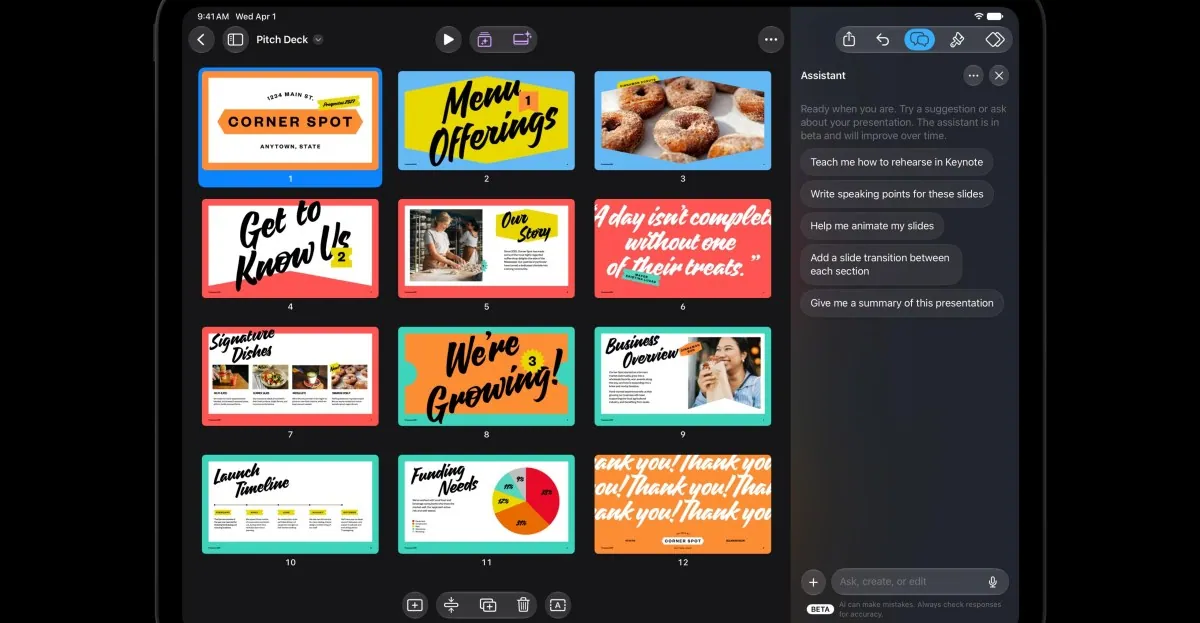
Apple is giving its productivity suite a built-in AI assistant, embedding a chatbot directly into Keynote, Pages, and Numbers that can read what's on the page and make changes to it on command.
The assistant runs on a combination of Apple's own AI models and technology from OpenAI, according to The Verge. That pairing lets it do more than generate generic text or slides. Because it can parse the actual context of a document, it can take on tasks specific to each app: in Keynote, that means designing and animating slides or refining an existing presentation; in Pages, drafting, restructuring, and editing written content; in Numbers, calculating and organizing data, suggesting chart types, and building custom tables.
That's a meaningful shift from the bolt-on AI features many productivity tools have shipped over the past couple of years, where a chatbot sits alongside your work rather than inside it. Apple's version is positioned to understand the document itself, not just respond to prompts in a vacuum.
The company is also opening the door to outside developers. Keynote, Pages, and Numbers now support the Model Context Protocol, a standard that lets third-party AI agents plug into the apps, on macOS 27 and later. MCP has been gaining traction industry-wide as a way to let AI tools interact with software more directly, and Apple adopting it signals the assistant isn't meant to be a closed, Apple-only experience forever.
The rollout is a beta, and it's gated: it works on devices compatible with Apple Intelligence running iOS 27, iPadOS 27, or macOS 27 or later. That's consistent with how Apple has staged its AI features since Apple Intelligence launched, limiting access to newer hardware and software before any wider release.
More AI across the creative suite
The chatbot in Keynote, Pages, and Numbers is one piece of a larger wave of updates hitting Apple's creative apps. Pixelmator Pro, which Apple owns, is adding a Generate Fill tool that lets users edit part of an image just by describing the change they want. Apple says the feature automatically matches the lighting, perspective, and texture of the surrounding image so the edit blends in rather than looking pasted on.
Logic Pro, on Mac and iPad, is getting the most visible overhaul: a redesign built around Apple's Liquid Glass visual language, plus its own AI assistant. Apple says that assistant can set up a vocal track from a single prompt and make edits to existing projects. Logic Pro's Browser on Mac is also being redesigned, now using on-device AI to automatically analyze, classify, and tag sounds as they're added, cutting down on manual organization.
Final Cut Pro is picking up changes too, though more on the content side than the AI side. The update brings templates, graphics, titles, and transitions into the app through MotionVFX, and Apple is building a Content Hub directly into Final Cut Pro with a library of stock videos, photos, and backgrounds.
All of these updates fall under what Apple calls its Creator's Studio, and existing subscribers will get them for free starting in November.
Taken together, the update reflects where Apple is pushing its software: AI that's woven into the tools people already use for actual work, rather than a separate chatbot app. Pairing its own models with OpenAI's suggests Apple is still filling gaps in its own AI stack rather than going it alone, even as it builds the infrastructure, like MCP support, to let its apps work with a broader AI ecosystem down the line. The real test comes once the beta reaches more users and reviewers can judge how well the assistant actually handles messy, real-world documents instead of demo-ready ones.


