Anthropic's New Reporting Tools Try to Answer the Question Every CFO Is Asking About AI
As enterprise AI spending surges, Anthropic is betting that proving ROI will matter more than winning the model wars.
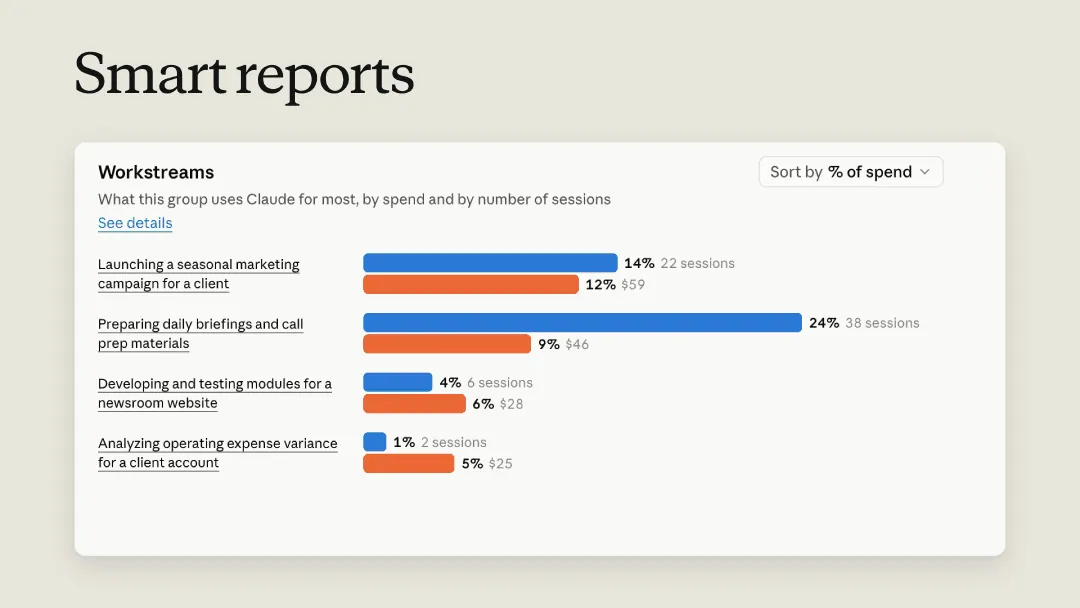
Anthropic wants its customers to see the receipts. On Wednesday, the AI lab rolled out a new suite of reporting tools built to show enterprise customers exactly what they're getting for their money when they use Claude Code, Anthropic's AI coding assistant.
The timing isn't an accident. Anthropic told investors this week that it turned an operating profit in the second quarter, and that net revenue retention hit 900% — meaning customers who were spending with Anthropic in Q3 2025 are now spending nine times as much a year later. That's an extraordinary growth curve for any software business. It also means Anthropic has a lot riding on convincing those same customers that the spending is worth it.
The new tools pull from internal analytics and employee surveys to let managers track a team's work over a chosen time period: what got built, what it cost, and where the workflow broke down. Anthropic says the reports will also flag specific recommendations for improving results, and that none of this data will be used to train its models by default. The company is pairing the reporting features with pooled group budgets, giving teams a way to manage token spending collectively rather than tracking it person by person.
The ROI question enterprises keep asking
The push addresses a real gap in how companies are approaching AI adoption. Businesses have been scrambling for clearer evidence of what their AI investments actually deliver, and the picture so far is uneven: usage at venture-backed startups is driving a lot of token spend, but most Fortune 500 companies aren't seeing major gains from the AI tools they've deployed, according to the source reporting.
A new report from Jellyfish, a developer tools company, puts some numbers behind that uncertainty — and behind Anthropic's position in the market. Based on data from 276,000 of its customers, Jellyfish found that Claude Code and other Anthropic-based tools remain the most widely used agentic coding tools, accounting for nearly a third of all proposed code changes submitted for review. Spending on those tools has grown 10x since the start of the year, though it still represents only about 2% of total engineering cost.
Nicholas Arcolano, Jellyfish's chief scientist, told TechCrunch that even a small slice of the budget matters when it's growing that fast. "Even if you're saying 2% is still small, that 10x growth is growth that most CFOs didn't plan for," Arcolano said. "We're certainly getting to the point where people are realizing, okay, it's not enough to just spend a bunch. You now have to optimize it, make it work."
That's precisely the gap Anthropic's new reports are designed to fill — giving finance and engineering leaders a way to justify spend that's scaling faster than anyone budgeted for.
Why switching is harder than it looks
Anthropic's lead among enterprise coding customers has held up despite competitive pressure. OpenAI's release of its Astra model this summer looked, on paper, like it could cut into Anthropic's share. So far, it hasn't shown up much in the adoption data.
Nikolas Albarran, Jellyfish's AI product lead, told TechCrunch that OpenAI's Codex tool took a long time to register meaningfully in Jellyfish's data, even with Astra's release. He said the online discourse paints a more competitive picture than the usage numbers support: "Everyone in the Valley is like, 'Oh, Codex is better.'" But in practice, he said, "Anthropic was just there with great enterprise motions, and they had an incumbent weight of their own — this stuff just worked and worked well, and a lot of people just put a lot of effort into standardizing workflows around it. And there's not a big enough reason to switch."
That inertia isn't just about which model writes better code. Albarran pointed to the heavy investment every major AI lab is making in forward-deployed engineering teams — AI consultants embedded directly inside customer organizations to help them get tools up and running. Anthropic's new reporting suite functions as a lighter-touch version of that same strategy: instead of sending engineers on-site, it gives customers the analytics to optimize on their own, while still keeping them anchored to Anthropic's platform.
As Albarran put it, the market is reaching a point where early adoption decisions start to calcify. "We're at a point now where it's mature enough, where once you're in, it's going to be harder and harder to switch because you've spent the effort," he said. Even tools that look similar on the surface end up with their own quirks — how they handle agents, how they manage files — and that makes the cost of switching real, even if it's not obvious from the outside.
For Anthropic, the message to customers is straightforward: stop guessing about whether your AI spend is working, and start measuring it. For the market more broadly, the Jellyfish data suggests the next phase of enterprise AI adoption won't be decided by which model benchmarks best. It'll be decided by which company can prove, in hard numbers, that the investment is paying off, and make it just inconvenient enough to leave once it does.


