AMD's Helios Rack System Lands Microsoft as Nvidia's First Real Challenger Gains Steam
The chipmaker's rack-scale AI system, already backed by Meta, OpenAI and Oracle, is now headed to Microsoft's Azure data centers later this year.
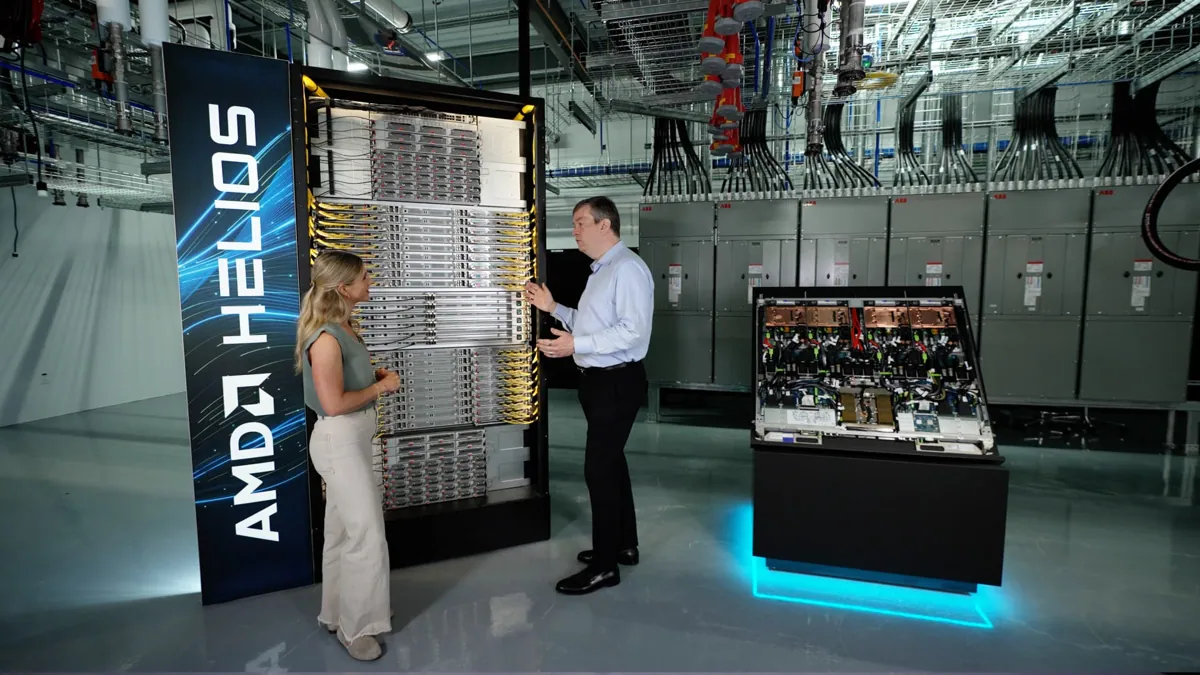
AMD is about to start shipping the first rack-scale AI system with a real shot at challenging Nvidia's dominance, and Microsoft just signed on as its newest customer.
The system is called Helios, and Microsoft announced Monday it will deploy it across its data centers, putting the Windows maker alongside Meta, OpenAI, Oracle and Tata Consultancy Services on the growing list of companies betting on AMD's answer to Nvidia's Grace Blackwell and Vera Rubin platforms. AMD says shipments to customers, including Microsoft, begin later this year. Neither company disclosed financial terms or how much computing capacity is involved.
Microsoft CEO Satya Nadella framed the move as part of a broader effort to diversify its infrastructure. "We are expanding the Azure infrastructure portfolio with AMD Helios to give customers the performance, scale and choice they need to build and run the next generation of AI applications," he wrote in a press release, according to CNBC.
Helios will handle inference for frontier models, both for Microsoft's own AI development and for its Azure customers. Microsoft is also adding two new computing instances built on AMD's latest "Venice" CPUs, one aimed at agentic AI and data pipelines, the other at semiconductor design work.
None of this comes out of nowhere. AMD chips have powered Microsoft's Surface laptops and Xbox consoles for years, and Microsoft was the first company to adopt AMD's MI300X GPU back in 2023, the chip that first put real pressure on Nvidia's AI hardware. Microsoft also builds its own in-house Maia chips, so Helios adds a third leg to an infrastructure strategy that's increasingly about not depending on any single supplier — Nvidia included.
That need for compute is only getting more urgent. Microsoft announced seven in-house models in June as it pushes harder into building its own AI rather than just running others'. Its AI products so far have had a mixed reception, from the 365 Copilot assistant to the GitHub Copilot coding agent, and Microsoft has been the worst-performing stock among the "Magnificent Seven" this year. More compute, spread across more chip suppliers, is part of how it's trying to change that trajectory.
What's actually inside Helios
Helios is AMD's attempt to package everything it builds in-house — GPUs, CPUs, networking chips and software — into a single rack-scale product, the same basic idea behind Nvidia's Grace Blackwell and Vera Rubin systems. AMD data center head Forrest Norrod told CNBC the goal is straightforward: minimize the cost of running AI workloads at scale. "We're very focused on providing the best total cost of ownership, the lowest cost per token, all in," he said, adding that customers are confirming AMD is hitting that mark.
CNBC got an early look at the system inside a Texas data center lab where AMD develops and tests it. Each of Helios's 18 compute trays pairs four Instinct GPUs with a single EPYC CPU, and each tray carries up to 12 networking chips built on technology AMD picked up when it bought networking company Pensando in 2022. The whole rack weighs up to 7,000 pounds, making it bulkier than Nvidia's Vera Rubin.
Cost estimates from the Futurum Group put Helios at roughly $5 million to $5.5 million per system, compared with an estimated $3.5 million to $4 million for Nvidia's Vera Rubin. AMD wouldn't confirm pricing. In May, AMD CEO Lisa Su told CNBC's Jim Cramer that Helios holds "significant benefits" over Nvidia's rack systems specifically around inference, memory bandwidth and memory capacity.
A decade in the making
Helios didn't materialize overnight. AMD's largest deal to date, the nearly $50 billion acquisition of programmable chip maker Xilinx in 2022, fed into the system's development, as did the roughly $5 billion purchase of server maker ZT Systems in 2025 and a string of smaller software acquisitions that built out ROCm, AMD's open-source alternative to Nvidia's CUDA software platform.
The CPU side of the story goes back further. AMD had a genuinely competitive data center chip in 2003 that briefly grabbed close to a quarter of the market, before a run of delays and missteps cost it that ground, triggered layoffs and shrank revenue. The turnaround began when AMD unveiled its first EPYC server chip in 2017. "One of the things that we did is we laid out our road map in detail for three generations, which is very unusual," Norrod told CNBC. "And we delivered exactly what we said." He credited Su's 12 years running the company for reshaping it into what he called "a very different AMD."
That EPYC comeback is part of why AMD has an edge Nvidia doesn't: it already builds server CPUs at scale, while Nvidia only shipped its first one in 2021 and only sharpened its focus there this year.
The market AMD is chasing
The numbers show how much room AMD has to gain. Nvidia controls more than 95% of the data center GPU market, according to Futurum Group, versus roughly 4.5% for AMD. But Helios represents AMD's best shot yet at cutting into that. AMD says eight of the top 10 AI companies already run workloads on its Instinct GPUs, a list that includes OpenAI, Cohere and Elon Musk's SpaceXAI. Meta committed in February to as much as 6 gigawatts of AMD GPUs over time, with 1 gigawatt landing on Helios racks this year.
Futurum CEO Daniel Newman sees real upside for AMD. "I think there's a serious case in which AMD does great and can get to 20% and 25%. And by the way, this is hundreds of billions of dollars of revenue," he said.
The financial trajectory backs that up somewhat: data centers made up the majority of AMD's revenue in the first quarter of 2026, up 57% year over year, and AMD says it expects tens of billions of dollars in data center AI revenue starting in 2027, mostly from Helios.
Still, hardware is only half the battle. Counterpoint Research analyst Neil Shah said AMD's chips are "on par" with Nvidia's, but the real differentiator is software. "With CUDA, I think Nvidia has a bigger ecosystem, and it's quite ahead versus AMD," he said.
Newman framed the open question facing AMD bluntly: is it winning new customers because Helios is genuinely better, or simply because AI compute is so scarce that anything AMD can produce will find a buyer? The answer will likely play out over the next few years, as Helios deployments at Microsoft, Meta, OpenAI and Oracle move from commitments to running infrastructure.


