Zoox Recalls 105 Robotaxis After One Drove Straight Into an Active Fire Scene
The Amazon-owned company says its software failed to recognize heavy smoke obscuring an emergency scene in Las Vegas, adding to a growing list of autonomous vehicles struggling to yield to first responders.
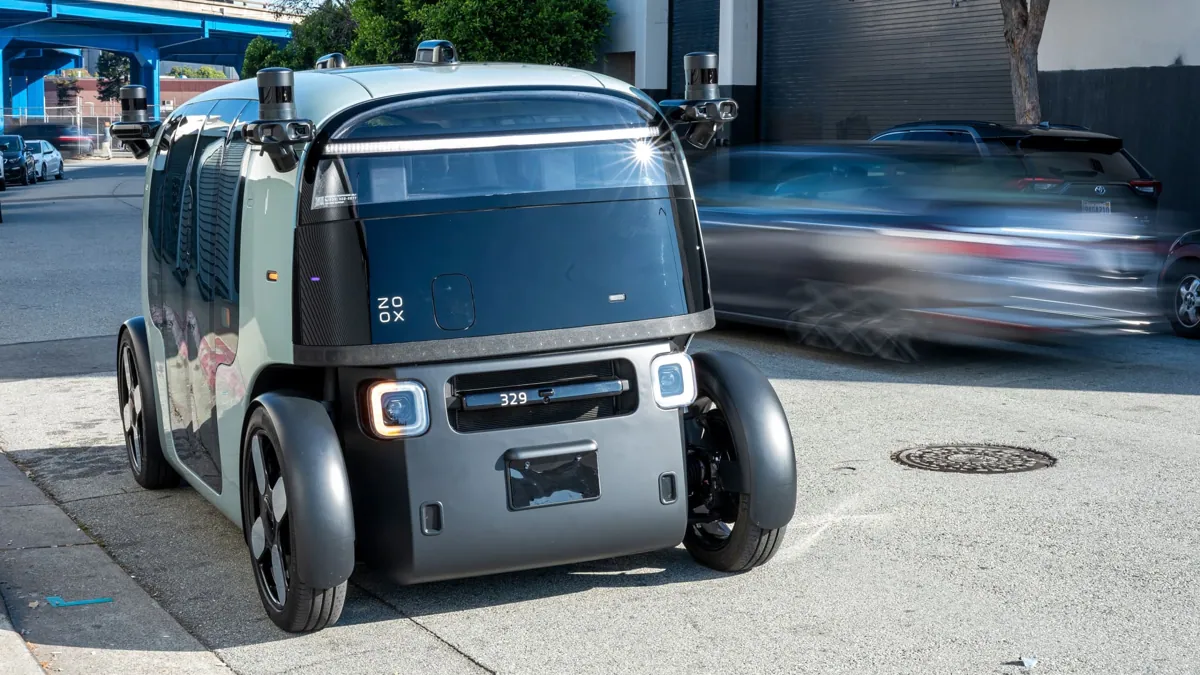
Amazon's self-driving subsidiary Zoox is recalling software running on 105 of its robotaxis after one of its driverless vehicles drove into thick smoke at an active fire scene last month, unable to recognize what was blocking its path.
The incident happened on June 20 in Las Vegas. According to Zoox's report to the National Highway Traffic Safety Administration, an unoccupied robotaxi ran into heavy smoke that was covering an emergency scene the fire department hadn't yet marked off with cones. The vehicle drove into it, then braked hard and tried to steer away before stopping. A Zoox employee monitoring the vehicle remotely — the company calls this teleguidance — told it to back out. First responders then set up cones to seal off the area.
Zoox says nobody was hurt, and that its investigation turned up no other instances of the same failure. The company notified NHTSA of the voluntary recall on July 8, saying it only became aware of the smoke-detection gap after the June incident.
It's not the first time Zoox has had to patch its software this way. The company issued multiple recalls last year to fix problems with lane crossings and its ability to anticipate how nearby cars and pedestrians would move. This latest one lands at a particularly sensitive moment for the entire autonomous vehicle industry.
A regulator running out of patience
Just last week, NHTSA Administrator Jonathan Morrison sent a directive to AV developers demanding they fix a broader problem: robots cars that don't get out of the way of firefighters, police, and ambulances. Morrison wrote that the agency has "identified a clear pattern of driverless AVs interfering with law enforcement and other first responders," pointing to cases where autonomous vehicles pushed into active emergency scenes, blocked ambulances or fire trucks, or simply failed to register flashing lights, flares, smoke, fire, or traffic cones as signals to stop or reroute.
The letter didn't call out any specific company by name, but the timing makes the connection to Zoox hard to miss. Morrison gave AV developers and operators until the end of July to bring their proposed fixes to the agency — a tight deadline that suggests regulators see this as more than a one-off glitch.
Zoox isn't the only company facing this kind of scrutiny. Waymo, the Alphabet-owned robotaxi leader, recalled roughly 3,900 vehicles last month after some of them drove into closed construction zones on freeways, which NHTSA said raised the risk of a crash. Waymo currently runs about 4,000 automated vehicles across the country and remains the dominant player in the U.S. robotaxi market by a wide margin.
Where Zoox stands right now
Zoox is still in a much earlier phase of its rollout than Waymo. Amazon bought the company for $1.3 billion in 2020, and its vehicles look nothing like a converted sedan — they're purpose-built driverless shuttles with no steering wheel, no pedals, and four seats arranged in a face-to-face carriage layout.
Right now, Zoox offers free rides in parts of Las Vegas and San Francisco and has opened up limited hailing zones in Miami and Austin for select users. It's also testing its vehicles in six other U.S. cities, all part of an effort to close the gap with Waymo before wider commercial launch.
That expansion plan is exactly why an incident like this one carries weight beyond the immediate fix. A robotaxi that can't distinguish an unmarked emergency scene from ordinary road conditions is a problem Zoox needs solved well before it's running fleets at Waymo's scale, especially with NHTSA now watching the entire industry's handling of first responders as a distinct category of risk rather than a series of isolated incidents.
For now, Zoox says the June 20 event was a one-time failure and that the software patch addresses it. Whether NHTSA agrees that's sufficient, and what the rest of the AV industry submits by the end of the month, will say a lot about how seriously regulators plan to police this specific failure mode going forward.


