Amazon Teaches Alexa Plus to Actually Understand Your Smart Home
A new developer toolkit and support for the Model Context Protocol let Alexa Plus route complex requests to specific appliances and, soon, book your hotel and pay for it too.
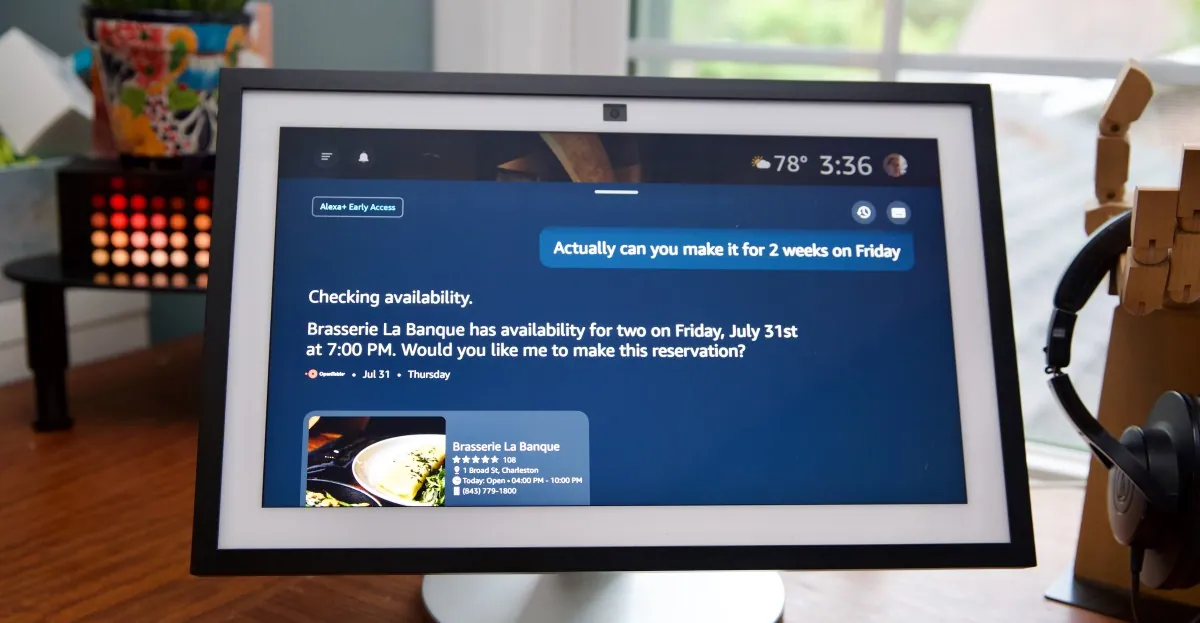
Amazon is rolling out an update to Alexa Plus that lets its AI assistant reach deeper into your smart home and figure out, on its own, which device should handle a given request. The update adds support for products from Bosch, Delta, Ecovacs, iRobot, Yale Home, Whirlpool, Tapo, and Eufy, among others, with Alexa automatically routing commands to the right gadget instead of requiring you to specify one.
The example Amazon is using to show off the feature is a washing machine. Tell Alexa Plus, "my kid's soccer jersey could use a deep clean, but the tag says cold wash only," and the assistant is supposed to parse that, check the washer's available cycles, and pick the setting that fits, cold water and heavy-duty cleaning, without you touching a dial. That's a meaningfully different task than the voice commands Alexa has handled for years. It's not "turn on the lights." It's interpreting a real-world constraint and translating it into the right machine setting.
What makes that possible, according to Amazon, is a new AI developer toolkit built specifically to let device makers plug their products into Alexa Plus, including ones with quirky or nonstandard capabilities that the assistant couldn't previously handle. Instead of Amazon building custom integrations for every appliance one at a time, the toolkit is meant to give manufacturers a more direct path to making their devices Alexa-legible.
From smart speakers to a broader AI assistant
This update sits inside a bigger shift Amazon has been making with Alexa Plus since its wide launch in February. Unlike the original Alexa, which mostly executed single, simple commands, Alexa Plus is built to handle multi-step requests and help users build voice-driven routines. But its usefulness outside the smart home has so far been limited to a short list of partners: Ticketmaster, OpenTable, Uber, Thumbtack, Expedia, Yelp, Square, and Angi.
Amazon's fix for that bottleneck is adopting the Model Context Protocol, or MCP, an open-source standard that lets AI systems connect to outside tools and services in a more standardized way. MCP has been gaining traction across the AI industry as a common language for hooking models up to external systems, and Amazon's use of it here signals an effort to make Alexa Plus extensible in the same way, rather than negotiating bespoke integrations with every company that wants in.
The near-term payoff is a wave of new partners. Canva, Headspace, Priceline, Lyft, Cengage, Virgin Atlantic, and Weekend are among the companies building Alexa Plus integrations expected to launch later this year. Priceline's version sounds particularly ambitious: customers will reportedly be able to browse hotel listings and complete a booking entirely through conversation with Alexa. Priceline, along with Atom Tickets, Cengage, Fandango, and Taskrabbit, will also support payments through Amazon Wallet, meaning some of these interactions could go from "find me a hotel" to "book and pay for it" without leaving the assistant.
Why the routing problem matters
The smart home piece and the third-party services piece are really solving the same underlying issue: getting a general-purpose AI assistant to reliably act inside specific, siloed systems it wasn't originally built to understand. A washing machine's cycle menu and a hotel booking flow have nothing in common on the surface, but both require Alexa Plus to take a vague, human request and map it onto a rigid set of options controlled by someone else's software. That's a harder engineering problem than voice recognition ever was, and it's the reason smart assistants have spent years being good at timers and weather but bad at genuinely complex tasks.
By opening up a developer toolkit for smart home routing and standardizing on MCP for everything else, Amazon is betting it can outsource a lot of that integration work to the companies that already know their own products best, rather than building every connection in-house. If it works, Alexa Plus becomes less of a voice remote for a short list of approved apps and more of a general interface that can plausibly get bigger every time a new company ships an integration.
The near-term test will be whether these promised integrations, from Priceline bookings to appliance cycle selection, actually work as smoothly as Amazon's demo suggests once they're in customers' hands later this year.


