NASA's Long-Running Swift Observatory Is Falling Back to Earth
The gamma-ray-hunting spacecraft outlived its mission by two decades, but a failed rescue attempt means it's finally coming down.
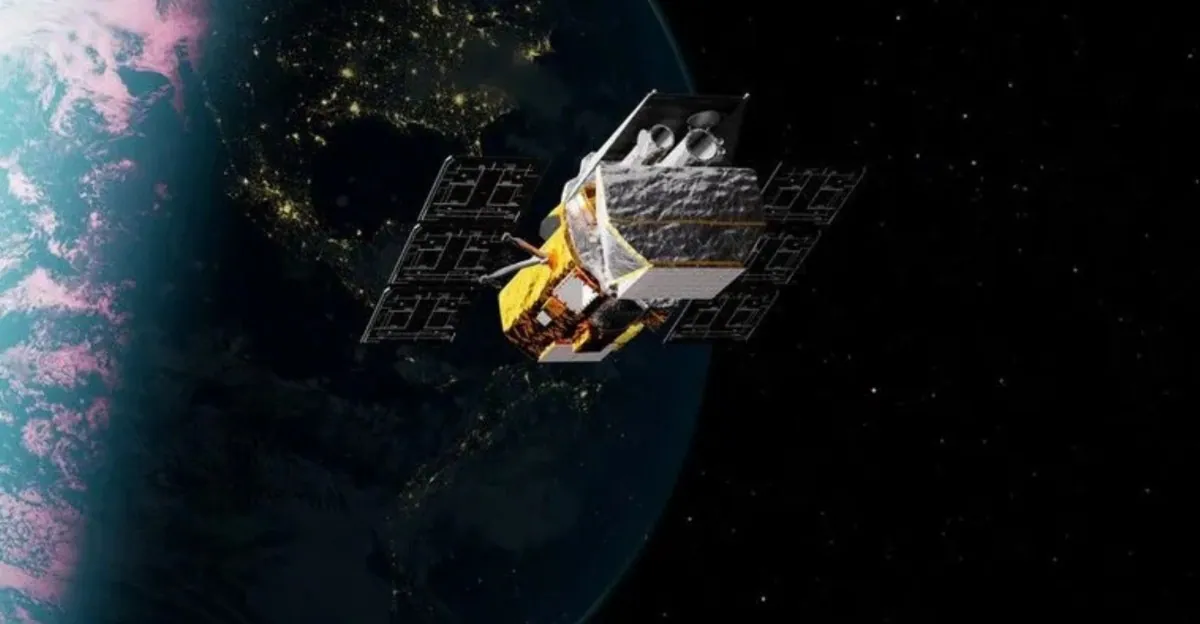
NASA's Swift Observatory is set to re-enter Earth's atmosphere on Wednesday, nearly 22 years after it launched, after efforts to boost it back into a higher orbit came up short.
The space agency says the truck-sized telescope is expected to hit the atmosphere at roughly 3:30AM ET, with a margin of error of about 11 hours either way. Most of the spacecraft should burn up on the way down, but NASA expects some components to survive re-entry and reach the surface.
That's not a reason for alarm, according to the agency. Swift's orbit has a low inclination, meaning any debris that does survive can only land within a narrow band of the planet, between 20.6 degrees south latitude and 20.6 degrees north latitude. NASA pegs the odds of the re-entry causing harm to anyone on the ground at roughly 1 in 2,100. NASA, working with Space Force, is continuing to track the descent and will update its predictions as the window narrows.
Swift itself is a sizable piece of hardware: about 3,200 pounds, standing 5.6 meters (18.4 feet) tall and 5.4 meters (17.7 feet) wide, though much of that width comes from its solar arrays rather than the main body of the spacecraft.
The telescope's fall wasn't supposed to happen this way, at least not yet. NASA had been attempting to use a spacecraft called Link to push Swift back into a higher, more stable orbit, but the rescue effort ran into attitude-control problems and was abandoned earlier this year. Without that boost, Swift's orbit kept decaying, a process accelerated by solar storms that dragged it progressively lower.
Swift launched to study gamma-ray bursts, the universe's most powerful explosions, and was originally designed for a two-year prime mission. It ended up running for roughly two decades, evolving into a general-purpose observatory that astronomers used across multiple wavelengths of light, well beyond its original gamma-ray focus.
NASA is tracking the re-entry on its mission blog, where it plans to post continued updates as Swift's final orbit plays out.