Alphabet's Spending Surge Sets Up a Tense Week for Amazon, Meta and Microsoft
Google's parent company posted its first-ever negative quarterly free cash flow after hiking AI spending plans, and Wall Street now wants to see whether its Big Tech rivals will follow the same expensive path.
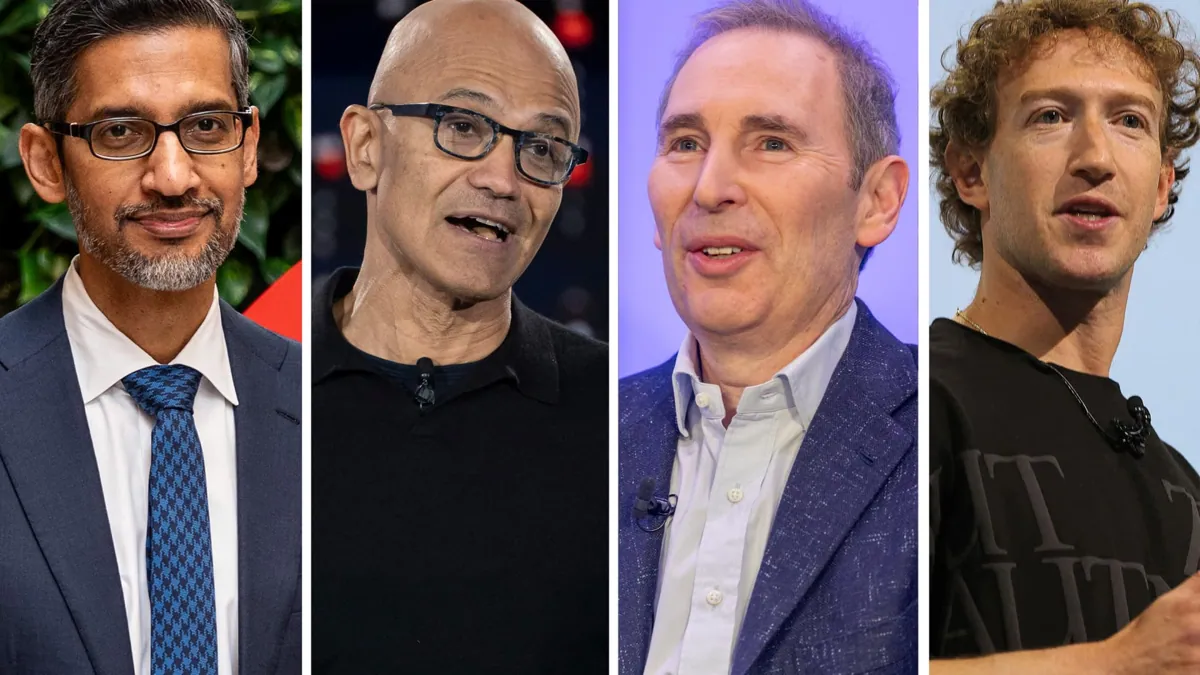
Alphabet just showed the market what happens when a hyperscaler pushes its AI spending even higher than expected: the stock gets punished, even when the underlying business is firing on all cylinders. Now three more tech giants have to decide whether they're willing to take that same risk.
Google's parent company kicked off Big Tech's earnings season this week, and the headline wasn't the business results, it was the money. Alphabet raised its 2026 capital expenditure forecast by $15 billion at the midpoint, putting the new range at $190 billion to $205 billion, and said spending will climb again in fiscal 2027. That's on top of already-massive outlays for data centers, chips and networking gear to keep pace with AI demand.
The cost of that ambition showed up immediately. Alphabet's second-quarter free cash flow went negative, with outflows of $5.8 billion, the first time that's happened in the company's history. Free cash flow, the cash left over after a company covers its operating costs and capital spending, is one of the clearest signals of financial health, and investors watch it closely as a check on how much a company can actually afford to spend.
The numbers came despite a genuinely strong quarter. Google Cloud revenue jumped 82% year over year, evidence that enterprise demand for AI computing is real and growing. But that wasn't enough to offset the sticker shock. Alphabet's stock fell 7% the day after earnings, extending a losing streak, and was on track to close out the week down nearly 8%, making it one of the market's worst performers. Alphabet has also said it will sell $85 billion worth of stock to help offset the spending, a move that's added to the pressure on shares.
"Capex trends are going to be the number one focus," said Jeff Marks, portfolio director for the CNBC Investing Club, during Friday's Morning Meeting. Marks pointed to a shift in how investors are treating this spending cycle: they're no longer giving hyperscalers a blank check just because they're chasing AI demand. Companies now need to show a path to actually making money on all that infrastructure, not just promise it's coming.
"They are spending because they see the demand and they don't want customers to go elsewhere," Marks said. "But you can't ignore what it's done to free cash flow, either."
Jim Cramer, who leads the Investing Club, said he wasn't comfortable with the scale of Alphabet's new spending plans, even accounting for the cloud unit's growth. That tension, strong demand versus ballooning costs, is exactly what's rattling the other three megacaps heading into their own earnings reports.
Meta faces the sharpest test
Meta and Microsoft report Wednesday evening, with Amazon following after Thursday's close. Of the three, Meta may draw the most scrutiny.
The company has already been pouring money into AI infrastructure and, more recently, has been preparing to launch a public cloud business that would let it sell off excess computing capacity to outside customers, a potential new way to justify the spending.
Investors have shown they won't go easy on Meta over this. Last quarter, the company raised its 2026 capex guidance to a range of $125 billion to $145 billion, a $10 billion bump at the midpoint, citing rising costs for memory chips and other data center components. Shares dropped 9% on the news. At the time, Cramer argued Meta got less benefit of the doubt than rivals because, unlike Amazon, Google and Microsoft, it doesn't run a cloud business. Now that Meta has its own cloud ambitions in motion, it may finally get more room to spend. One thing working in its favor: free cash flow rose a healthy 20% last quarter and beat estimates.
Amazon gets a green light from Google
For Amazon, Alphabet's results arguably make the case for staying the course. Google Cloud's growth and its expanding backlog of contracted business suggest enterprise appetite for AI infrastructure isn't slowing down, a good sign for Amazon Web Services, still the largest cloud infrastructure provider in the world.
Amazon has already committed heavily to expanding AWS, and like Google, it's leaning more on custom-built AI chips. Last quarter, the company held its 2026 capex forecast steady at around $200 billion. Amazon, too, is expected to post negative free cash flow this year, and it's been turning to the corporate bond market to help cushion the impact of all that spending.
Microsoft's software problem
Microsoft runs on a different fiscal calendar than its peers, but in April it laid out roughly $190 billion in planned capital spending for calendar 2026. Its free cash flow has also been squeezed in recent quarters.
Azure's demand trends look encouraging, but Alphabet's week showed that demand alone doesn't guarantee investors stay patient. Microsoft has an added complication its rivals don't share as directly: heavy exposure to enterprise software through Office and related platforms, a category investors increasingly worry AI could hollow out. Starbucks said last month it would drop software tools from Microsoft and IBM in favor of building its own AI tools in-house, and IBM's recent warning of a soft quarter only sharpened those concerns.
Microsoft has been the worst performer among the group this year, down 20%. There was one bright spot recently: a Citi analyst offered a positive read on Copilot, Microsoft's AI assistant that's faced persistent criticism. Cramer said he was surprised by the research, but any real improvement in Copilot's reception could help make Microsoft's broader software lineup a tougher target for disruption.
Meta and Amazon shares each slid roughly 6% to 7% this week, while Microsoft was down more than 2%. All three now walk into earnings with the same question Alphabet just answered the hard way: how much can they spend on AI before investors stop believing the payoff is worth it.


